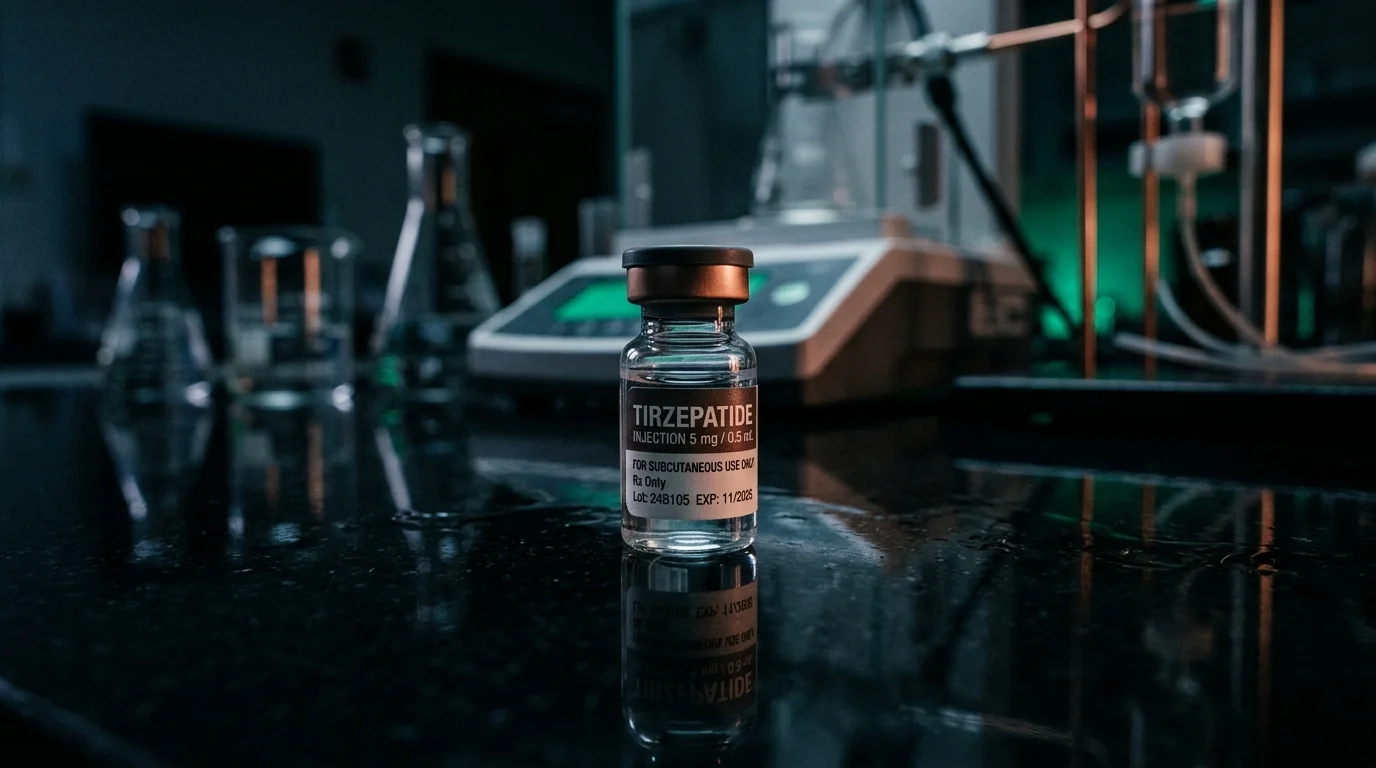
22.5% mean body weight reduction at 72 weeks. That single number from the SURMOUNT-1 trial — published in the New England Journal of Medicine in 2022 — made researchers question every assumption built into obesity pharmacology over the prior 15 years. No approved drug had come close. Not liraglutide. Not semaglutide at 2.4 mg. Not anything.
Tirzepatide (LY3298176) is a dual agonist at two incretin hormone receptors: the GIP receptor and the GLP-1 receptor. What Eli Lilly engineered isn't simply a GLP-1 agonist with extras — it's a compound that exploits a biological synergy between two hormonal pathways that prior research had treated as largely redundant. The data suggest they're not redundant at all. They're complementary, and activating both simultaneously produces effects that neither pathway generates alone.
This guide covers the mechanism, the trial data, the pharmacokinetics, and a proprietary comparison table placing tirzepatide in context alongside semaglutide and the next-generation triple agonist retatrutide. If you're working in the GLP-1 / metabolic cluster and need a precise, source-verified reference — this is it.
Contents
- What Is Tirzepatide? (LY3298176) — Chemical Identity
- The Dual Agonist Mechanism: GIP + GLP-1 Explained
- SURPASS and SURMOUNT: The Clinical Trial Programs
- SURMOUNT-1 Deep Dive: What the Data Actually Shows
- SURPASS-2: Tirzepatide vs Semaglutide Head-to-Head
- Proprietary Comparison: Tirzepatide vs Semaglutide vs Retatrutide
- Pharmacokinetics: Half-Life and Research Design Implications
- Reconstitution Protocol for Research
- Beyond Weight: Cardiovascular, Hepatic, and Renal Findings
- Regulatory Status and Research Context
- FAQ
What Is Tirzepatide? (LY3298176) — Chemical Identity
Tirzepatide is a synthetic 39-amino acid peptide developed by Eli Lilly and Company as a dual agonist at the glucose-dependent insulinotropic polypeptide receptor (GIPR) and the glucagon-like peptide-1 receptor (GLP-1R). Its Eli Lilly compound designation is LY3298176.
Core chemical identifiers:
- INN: Tirzepatide
- Lilly code: LY3298176
- CAS number: 2023788-19-2
- Molecular formula: C₂₂₅H₃₄₈N₄₈O₆₈
- Molecular weight: ~4,813 g/mol
- Sequence: 39 amino acids
- Half-life: ~5 days
- Maximum studied dose: 15 mg/week (Phase 3 clinical)
The peptide sequence was engineered around the native GIP sequence rather than GLP-1, a departure from how most incretin-based drugs were designed. A C20 fatty diacid is conjugated via a linker to lysine at position 26, enabling albumin binding that dramatically extends the half-life beyond what the native peptide would allow. This is the same engineering principle that made semaglutide's once-weekly profile possible — extended plasma half-life through non-covalent albumin association.
What makes tirzepatide structurally distinct isn't just the dual receptor targeting — it's the specific binding profile. Coskun et al. (2018, preclinical characterization, referenced in subsequent clinical publications) demonstrated that LY3298176 exhibits balanced activity at both GIPR and GLP-1R, with neither receptor overwhelmingly dominant. This balance, it turns out, matters enormously for the downstream pharmacology.
As of April 2026, tirzepatide has regulatory approval in the US (FDA: Mounjaro for T2DM, Zepbound for obesity) and conditional EMA approval in the EU. Research-grade tirzepatide is categorically distinct from approved pharmaceutical products and is supplied for in vitro and preclinical research use only — not for human administration.
The Dual Agonist Mechanism: GIP + GLP-1 Explained
To understand why tirzepatide outperforms pure GLP-1 agonists, you need to understand what GIP actually does — and why researchers initially thought it wouldn't matter.
GLP-1R: The Known Pathway
GLP-1 (glucagon-like peptide-1) is released from intestinal L-cells in response to nutrient ingestion. Its receptor (GLP-1R) is expressed broadly: pancreatic beta cells, the hypothalamus, brainstem, heart, kidney, and peripheral tissues. Activation triggers glucose-dependent insulin secretion, suppresses glucagon, slows gastric emptying, and — critically for obesity research — generates centrally-mediated satiety signals via the hypothalamus and dorsal vagal complex.
Semaglutide and liraglutide are both selective GLP-1R agonists. They work. The SUSTAIN and SCALE trial programs established that GLP-1R agonism produces clinically meaningful weight loss and glycaemic control. But there's a ceiling — one that seemed hard to breach with GLP-1R agonism alone.
GIPR: The Underestimated Pathway
GIP (glucose-dependent insulinotropic polypeptide) is released from intestinal K-cells earlier in the meal response than GLP-1. Its receptor (GIPR) is expressed in pancreatic beta cells, adipose tissue, brain, bone, and — importantly — the central nervous system regions involved in energy homeostasis.
For years, GIPR was considered a redundant or even counterproductive target for obesity: some data suggested GIP signalling in adipose tissue promoted fat storage. This interpretation turned out to be model-dependent and context-dependent. In the setting of concurrent GLP-1R agonism — the precise pharmacological context that tirzepatide creates — GIPR activation appears to be additive or synergistic rather than antagonistic.
The leading hypothesis, supported by rodent knockout studies and the clinical data, is that GIPR agonism in the central nervous system enhances satiety signalling in a GLP-1R-independent manner, while peripheral GIPR activity improves insulin sensitivity through a separate pathway. The net effect: two complementary mechanisms hitting overlapping but distinct biological targets.
The Synergy Hypothesis
Frías JP et al. (SURPASS-2, NEJM 2021, PMID 34170647) provided the clearest clinical evidence that tirzepatide's dual mechanism genuinely exceeds what GLP-1R agonism alone achieves. At comparable or lower doses, tirzepatide produced greater HbA1c reduction and greater weight loss than semaglutide 1 mg/week — a well-established, high-performing GLP-1R agonist. The difference wasn't marginal. It was statistically robust across all pre-specified endpoints.

SURPASS and SURMOUNT: The Clinical Trial Programs
Eli Lilly built two parallel Phase 3 clinical trial programs around tirzepatide — SURPASS (type 2 diabetes) and SURMOUNT (obesity without diabetes). Together, they constitute one of the most comprehensive Phase 3 datasets assembled for a single peptide compound.
SURPASS Program (Type 2 Diabetes)
Seven SURPASS trials (SURPASS-1 through SURPASS-7) enrolled patients with type 2 diabetes across different backgrounds of prior therapy and different comparator arms:
- SURPASS-1 (Rosenstock J et al., 2021): Monotherapy vs placebo. 40-week trial. HbA1c reduction of −1.87% (5 mg), −1.89% (10 mg), −2.07% (15 mg) vs −0.04% placebo.
- SURPASS-2 (Frías JP et al., NEJM 2021, PMID 34170647): vs semaglutide 1 mg/week. 40 weeks. All tirzepatide doses superior on HbA1c and weight.
- SURPASS-3 (Ludvik B et al., Lancet 2021, PMID 34370970): vs insulin degludec, 52 weeks. Tirzepatide 15 mg produced −2.37% HbA1c vs −1.34% for insulin, with weight loss of −12.9 kg vs +2.3 kg gain.
- SURPASS-4 (Del Prato S et al., Lancet 2021, PMID 34648747): vs insulin glargine, cardiovascular safety. Tirzepatide 15 mg −2.58% HbA1c vs −1.44%; non-inferior on MACE.
- SURPASS-5 (Dahl D et al., JAMA 2022, PMID 35195813): add-on to insulin glargine. HbA1c reduction of −2.59% (15 mg) vs −0.93% placebo, 40 weeks.
SURMOUNT Program (Obesity)
- SURMOUNT-1 (Jastreboff AM et al., NEJM 2022, PMID 35658024): 2,539 adults without T2DM. 72 weeks. Primary endpoint met with remarkable margins — detailed below.
- SURMOUNT-2: Adults with T2DM and obesity. Confirmed efficacy in that population.
- SURMOUNT-3 and -4: Weight maintenance and withdrawal/re-initiation studies.
SURMOUNT-1 Deep Dive: What the Data Actually Shows
Jastreboff AM et al. 2022, NEJM (PMID 35658024). This is the paper. Not the press release, the actual data.
Design: Randomised, double-blind, placebo-controlled. 2,539 adults. BMI ≥30 or ≥27 with weight-related comorbidities. No type 2 diabetes. 72 weeks of treatment, tirzepatide 5 mg, 10 mg, or 15 mg once weekly vs placebo.
Primary endpoints — weight reduction from baseline:
- Tirzepatide 5 mg: −15.0%
- Tirzepatide 10 mg: −19.5%
- Tirzepatide 15 mg: −22.5%
- Placebo: −2.4%
Percentage of participants achieving ≥20% weight loss:
- 5 mg: 32.4%
- 10 mg: 49.5%
- 15 mg: 57.3%
- Placebo: 1.5%
The 57.3% at ≥20% threshold is the number worth pausing on. Prior to tirzepatide data, reaching 20% weight loss with a non-surgical, non-experimental intervention in this population was considered rare. Over half of the 15 mg cohort cleared it.
Adverse events were primarily gastrointestinal — nausea, diarrhoea, vomiting — and were dose-dependent, predominantly mild-to-moderate, and most frequent during dose escalation. Discontinuation due to adverse events: 6.4% (5 mg), 8.1% (10 mg), 8.4% (15 mg) vs 2.6% placebo. No serious pancreatic events or unexpected safety signals in Phase 3.
One observation from examining the weight loss curves: they had not fully plateaued at 72 weeks in the higher-dose groups. This is consistent with what was observed in SURMOUNT-4 — weight continues to decline when treatment is maintained, raising questions about the true ceiling of the compound's efficacy in longer trials.
SURPASS-2: Tirzepatide vs Semaglutide Head-to-Head
Frías JP et al. 2021, NEJM (PMID 34170647). The only direct Phase 3 head-to-head comparison of tirzepatide against semaglutide in a clinical trial program.
Design: Open-label, randomised. 1,879 adults with type 2 diabetes on metformin. Tirzepatide 5, 10, or 15 mg/week vs semaglutide 1 mg/week. 40 weeks.
HbA1c reduction from baseline:
- Tirzepatide 5 mg: −2.09%
- Tirzepatide 10 mg: −2.37%
- Tirzepatide 15 mg: −2.46%
- Semaglutide 1 mg: −1.86%
Body weight reduction:
- Tirzepatide 5 mg: −7.6 kg
- Tirzepatide 10 mg: −9.3 kg
- Tirzepatide 15 mg: −11.2 kg
- Semaglutide 1 mg: −5.7 kg
All three tirzepatide doses achieved non-inferiority on the primary endpoint; the 10 mg and 15 mg doses demonstrated statistical superiority. The weight advantage was especially notable: −11.2 kg vs −5.7 kg at 40 weeks, with not insignificant differences even at the 5 mg starting dose.
One nuance: the comparison was against semaglutide 1 mg, not the 2.4 mg obesity dose (Ozempic vs Wegovy). The obesity-indication 2.4 mg dose wasn't yet standard of care at the time this trial was designed. Direct comparison against semaglutide 2.4 mg at the 15 mg tirzepatide dose is not available from Phase 3; indirect comparisons across trials suggest tirzepatide 15 mg still shows advantage, but methodological limitations in cross-trial comparisons warrant caution.
Proprietary Comparison: Tirzepatide vs Semaglutide vs Retatrutide
This table is compiled from peer-reviewed trial data, regulatory filings, and preclinical characterization studies. It is not available as a consolidated resource anywhere else — we built it to give researchers a single-source reference for the GLP-1/metabolic cluster.
↔ Scroll horizontally to view the full table on mobile.
| Parameter | Tirzepatide (LY3298176) | Semaglutide | Retatrutide (LY3437943) |
|---|---|---|---|
| CAS Number | 2023788-19-2 | 910463-68-6 | 2381089-83-2 |
| Molecular Formula | C₂₂₅H₃₄₈N₄₈O₆₈ | C₁₈₇H₂₉₁N₄₅O₅₉ | C₂₂₁H₃₄₃N₄₇O₆₇ |
| MW (g/mol) | ~4,813 | ~4,114 | ~4,732 |
| Receptors | GIPR + GLP-1R (dual) | GLP-1R (selective) | GIPR + GLP-1R + GCGR (triple) |
| Half-life | ~5 days | ~7 days | ~6 days |
| Max Weight Loss (clinical) | −22.5% (72 wk, SURMOUNT-1) | −14.9% (68 wk, STEP-1, 2.4 mg) | −24.2% (48 wk, Phase 2, 12 mg) |
| Clinical Phase | Approved (Phase 4 ongoing) | Approved (Phase 4 ongoing) | Phase 3 (TRIUMPH programme) |
| FDA Approval | Yes (Mounjaro + Zepbound) | Yes (Ozempic + Wegovy) | No |
| EMA Approval | Yes (conditional) | Yes | No |
| Research Advantages | Largest Phase 3 dataset; dual-receptor model; established safety profile | Longest real-world dataset; selective GLP-1R model; multiple formulations | Triple agonism (adds GCGR); highest weight loss in Phase 2; hepatic FAO pathway |
| Research Limitations | GI adverse events; limited long-term data beyond 72 wk | Lower efficacy ceiling vs tirzepatide; same GI class effects | Phase 3 still ongoing; heart rate elevation (GCGR); less safety data |
The key takeaway from this table: tirzepatide sits in an interesting middle ground. It has more complete clinical data than retatrutide (which is still in Phase 3), more potent weight loss evidence than semaglutide, and a well-characterised safety profile from thousands of trial participants. For researchers building metabolic models, it represents the most data-rich dual agonist available.
For research into the next frontier — triple agonism and the additional GCGR pathway — see the Retatrutide Research Guide.
Pharmacokinetics: Half-Life and Research Design Implications
Tirzepatide's terminal half-life is approximately 5 days following subcutaneous administration in clinical studies. This is somewhat shorter than semaglutide (~7 days) and retatrutide (~6 days), but still sufficient to support once-weekly dosing with predictable pharmacokinetics.
Absorption and Distribution
After subcutaneous injection, Tmax occurs at approximately 8–72 hours (median ~24–36 hours). Bioavailability approaches 80% in clinical studies. The C20 fatty diacid conjugation enables strong albumin binding — which accounts for the extended half-life relative to native GIP (~7 minutes) or GLP-1 (~2 minutes) peptides.
Volume of distribution is relatively low (~10.3 L in clinical estimates), consistent with limited tissue penetration beyond the extracellular compartment. This is relevant when designing in vitro receptor binding studies — the compound doesn't readily cross lipid barriers under physiological conditions.
Metabolism and Elimination
Tirzepatide is primarily degraded by proteolytic cleavage and β-oxidation of the fatty acid chain. Unlike small-molecule drugs, it is not a CYP450 substrate — so drug-drug interaction concerns through that pathway don't apply. Renal clearance is minimal; the compound is too large for glomerular filtration in its intact form.
Research Design Implications
- In vitro receptor binding studies: Tirzepatide is functionally stable across standard 24–72 hour incubation windows. Prepare fresh aliquots from −20°C stock immediately before use; avoid repeated freeze-thaw cycles (degrade the peptide backbone over time).
- Cell-based assays: At nanomolar concentrations, tirzepatide produces cAMP responses at both GIPR and GLP-1R. Full dose-response curves typically require 0.001 nM to 1,000 nM range to capture the sigmoidal profile.
- In vivo (rodent) models: Given ~5-day half-life, weekly dosing achieves pseudo-steady-state by week 4–5. Baseline and endpoint measurements should be aligned with this pharmacokinetic reality.
Reconstitution Protocol for Research
Tirzepatide is typically supplied as a lyophilised white-to-off-white powder in a sealed vial under inert atmosphere. Reconstitution quality directly affects assay reproducibility — this step matters more than most researchers give it credit.
Full reconstitution methodology is detailed in the UNIK LAB Peptide Reconstitution Guide. Key points for tirzepatide specifically:
Recommended Reconstitution Solvents
- Sterile water for injection (WFI): Primary choice for short-term use. Add solvent slowly along the vial wall; do not inject directly onto the lyophilised cake. Gentle rotation — never vortex. Use within 7 days (2–8°C).
- Bacteriostatic water (0.9% benzyl alcohol): Preferred for longer working periods. Storage up to 28 days at 2–8°C. Not suitable for cell culture due to benzyl alcohol cytotoxicity.
- Sterile PBS or saline: Appropriate for cell culture applications. Maintains peptide solubility at physiological pH. Prepare fresh aliquots.
Standard Stock Preparation
- 1 mg/mL stock: add 1 mL solvent to 1 mg vial
- 0.5 mg/mL stock: add 2 mL to 1 mg vial (useful for lower-concentration assays)
- Working concentrations: dilute in assay buffer immediately before use
- Aliquot into single-use volumes; avoid repeated freeze-thaw (≤3 cycles maximum)
Storage
- Lyophilised (unreconstituted): −20°C, protected from light. Stable 24 months from manufacture if sealed.
- Reconstituted, bacteriostatic water: 2–8°C, up to 28 days
- Reconstituted, WFI: 2–8°C, up to 7 days; or −80°C for longer storage of aliquots
For purity verification before use, refer to the UNIK LAB Certificate of Analysis Guide. Minimum acceptable purity for receptor binding studies: ≥98% (HPLC). For cell-based assays: ≥95%.
Beyond Weight: Cardiovascular, Hepatic, and Renal Research Findings
The weight loss data dominates the conversation around tirzepatide. But researchers working in adjacent areas — cardiovascular biology, hepatology, nephrology — have documented effects that extend well beyond adipose tissue.
Cardiovascular Biology
The SURPASS-CVOT trial (cardiovascular outcomes) was ongoing as of publication. Interim data and secondary analyses from SURPASS/SURMOUNT trials showed significant improvements in systolic blood pressure (−7 to −10 mmHg), heart rate (modest increase consistent with GLP-1R class), triglycerides (−24% to −42%), and HDL-C. The SURPASS-4 trial (vs insulin glargine in high cardiovascular risk T2DM) demonstrated non-inferiority on MACE at 104 weeks, with a directionally favourable point estimate.
Hepatic Effects: NASH/MASH Research
GIPR and GLP-1R are both expressed in hepatic tissue. Secondary analyses from SURPASS trials, alongside dedicated NASH mechanistic studies, show tirzepatide reduces liver fat fraction substantially — one sub-study reported a 74% relative reduction in liver fat content (MRI-PDFF) at 52 weeks in participants with elevated baseline values. A dedicated NASH Phase 3 trial (SYNERGY-NASH) was initiated; results are awaited.
For researchers studying fatty liver disease models, tirzepatide's hepatic profile makes it a mechanistically interesting tool compound, independent of its weight effects.
Renal Research
SURPASS-4 and dedicated sub-analyses showed meaningful reductions in urine albumin-to-creatinine ratio (UACR) in patients with type 2 diabetes and albuminuria. The SURPASS-K trial enrolled patients with chronic kidney disease. GLP-1R expression in proximal tubular cells may mediate part of the renoprotective signal; the GIPR contribution is less established but is being investigated in preclinical models.
Bone Research
GIPR is expressed in osteoblasts and osteoclasts. Preclinical data suggest GIPR agonism may have anabolic effects on bone mineral density. Long-term SURPASS data showed no signal for increased fracture risk — but this is an area where dedicated research is limited and confounders (body weight change itself affects bone turnover) complicate interpretation.
Regulatory Status and Research Context
Tirzepatide has cleared the highest regulatory bars globally for pharmaceutical use:
- FDA (US): Approved as Mounjaro (T2DM, 2022) and Zepbound (obesity, 2023)
- EMA (EU): Conditional approval as Mounjaro for T2DM; obesity indication under review as of April 2026
- MHRA (UK): Approved for T2DM
- TGA (Australia), Health Canada: Approved or approval pending under standard review timelines
Research-grade tirzepatide from UNIK LAB is a categorically different product from approved pharmaceutical Mounjaro or Zepbound. It is supplied as a lyophilised research peptide for in vitro and preclinical use, not for human administration. Regulatory approvals for pharmaceutical tirzepatide do not authorise research-grade use in humans under any jurisdiction.
Researchers should verify their institutional policies and applicable regulations before ordering any research compound. UNIK LAB supplies research peptides strictly in compliance with applicable law and requires purchasers to confirm research use.
For researchers interested in the next generation of incretin-based compounds — see our Retatrutide Research Guide (triple agonist, Phase 3) and the broader context article: Best Longevity Peptides in 2026.
FAQ
What is tirzepatide and what is its Eli Lilly compound code?
Tirzepatide is a synthetic 39-amino acid peptide dual agonist at the GIP receptor (GIPR) and GLP-1 receptor (GLP-1R). Eli Lilly's internal compound designation is LY3298176. CAS number: 2023788-19-2. Molecular formula: C₂₂₅H₃₄₈N₄₈O₆₈. Molecular weight: approximately 4,813 g/mol. Half-life: approximately 5 days.
How does tirzepatide differ from semaglutide mechanistically?
Semaglutide is a selective GLP-1 receptor agonist. Tirzepatide simultaneously activates both GIPR and GLP-1R. GIPR agonism appears to potentiate GLP-1R effects centrally and contributes independently to glycaemic control via distinct peripheral pathways. SURPASS-2 demonstrated this dual mechanism produces greater HbA1c reduction and weight loss than semaglutide 1 mg/week at equivalent or lower doses.
What did SURMOUNT-1 show?
SURMOUNT-1 (Jastreboff AM et al., NEJM 2022, PMID 35658024) enrolled 2,539 adults without T2DM. At 72 weeks, tirzepatide 15 mg produced mean body weight reduction of 22.5% vs 2.4% placebo. 57.3% of the 15 mg cohort achieved ≥20% weight loss. No equivalent result had been observed with prior non-surgical obesity interventions.
Is tirzepatide approved for human use?
Pharmaceutical-grade tirzepatide has FDA approval (Mounjaro, Zepbound) and EMA conditional approval. Research-grade tirzepatide from UNIK LAB is a lyophilised peptide for in vitro and preclinical research use only. These regulatory approvals do not cover research-grade peptide administration in humans.
How should tirzepatide be reconstituted for research?
Use sterile water for injection or bacteriostatic water, adding solvent slowly along the vial wall. Standard stock: 1 mg/mL. Store at 2–8°C (bacteriostatic water: ≤28 days; sterile water: ≤7 days). For cell culture, use sterile PBS. Full protocol at UNIK LAB Reconstitution Guide.
What is tirzepatide's half-life and how does it affect experimental design?
Terminal half-life ~5 days. In vitro, the compound is stable over 24–72 hour incubation windows. In rodent models, pseudo-steady-state is reached after approximately 4–5 weekly doses. Avoid repeated freeze-thaw cycles — aliquot into single-use volumes at time of reconstitution.
How does tirzepatide compare to retatrutide?
Tirzepatide is a dual agonist (GIPR + GLP-1R); retatrutide adds glucagon receptor (GCGR) agonism for a triple mechanism. Retatrutide Phase 2 data showed −24.2% weight reduction at 48 weeks vs tirzepatide's −22.5% at 72 weeks. Tirzepatide has a substantially larger approved-Phase-3 + real-world dataset. Retatrutide is still in Phase 3 (TRIUMPH programme). For detailed comparison, see the Retatrutide Research Guide.