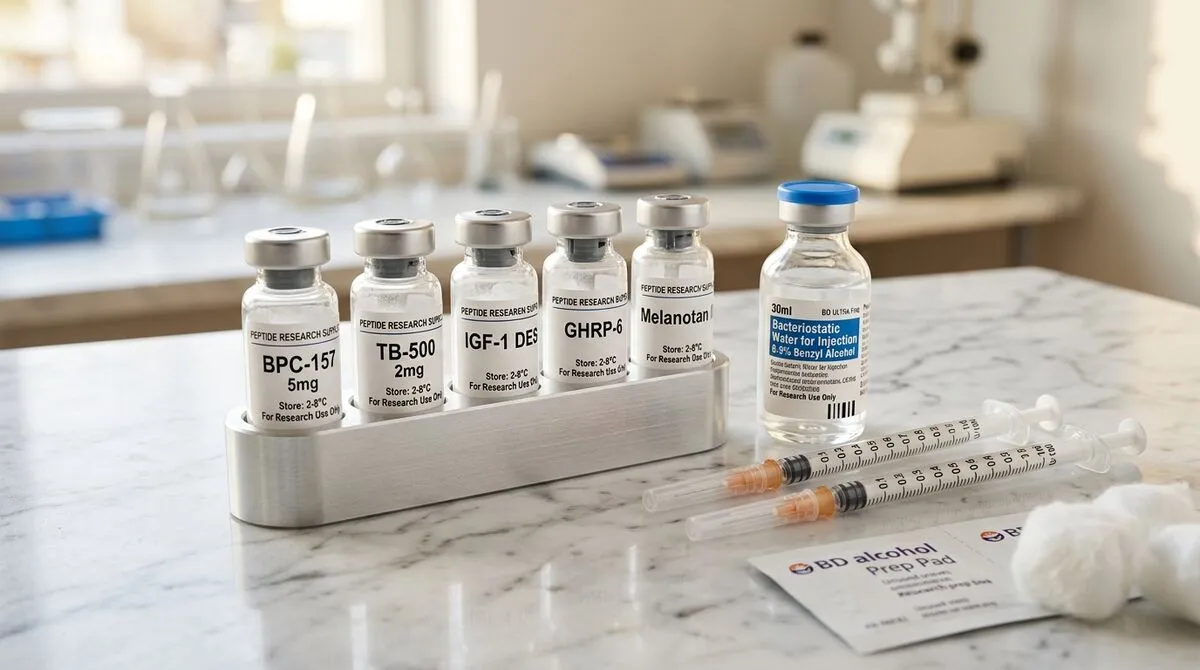
The largest research peptide supplier just vanished — and it took nearly a million researchers' go-to source with it. What Peptide Sciences represented wasn't just catalogue breadth or low prices; it was a known quantity in a market where quality is notoriously hard to verify. Finding a replacement isn't just about picking the next name on a Google results page.
This guide exists to give you a structured, analytical framework for evaluating where to buy research peptides in 2026 — regardless of whether you're replacing Peptide Sciences or sourcing for the first time. The criteria are objective. The checklist at the end of this article is actionable. The supplier recommendations are honest, including about their limitations.
Contents
- The State of the Research Peptide Market in 2026
- Purity Standards: What the Numbers Actually Mean
- Third-Party Verification: The Janoshik Standard
- Anatomy of a Valid Certificate of Analysis
- Shipping Zones and Customs Realities
- Payment Methods and What They Signal
- The Complete Supplier Evaluation Checklist
- Current Credible Suppliers (April 2026)
- Building a Resilient Sourcing Strategy
- FAQ
The State of the Research Peptide Market in 2026
Quick answer: The market is consolidating. Peptide Sciences' closure removed roughly 40% of US-market volume. The remaining established suppliers are absorbing that demand — but new opportunistic operators are also entering. Distinguishing between the two requires the criteria in this guide.
The research peptide supply landscape has never been stable. It's a market that sits at the intersection of legitimate scientific need, regulatory grey zones, and significant commercial opportunity — a combination that historically produces both excellent suppliers and outright fraudsters. What's changed in 2026 is the scale of disruption.
Peptide Sciences dominated not just through volume but through standard-setting. Their CoA infrastructure, customer service, and consistent quality forced other suppliers to compete on similar terms. With that benchmark removed, there's a genuine risk that market-wide quality standards drift downward — at least among the smaller, less established operators rushing to fill the vacuum.
Who Was Using Peptide Sciences?
The 990,000 monthly visitors figure covers a wide spectrum: academic researchers sourcing for preclinical studies, independent scientists running longitudinal experiments, and a significant population of informed non-institutional researchers exploring the biochemistry of peptide compounds. These groups have different risk tolerances and different analytical capabilities.
What they share is a need for documented, reliable supply. The most critical outcome of the Peptide Sciences closure isn't the loss of any specific compound — it's the disruption of established supplier relationships and the need to rebuild trust with new vendors from zero.
The Opportunist Problem
Within 72 hours of Peptide Sciences going dark, several new domains appeared leveraging the brand's name or closely adjacent keywords. This pattern is predictable and has been seen after every major supplier closure in this space. The opportunist playbook involves a professional website, recycled product descriptions, and either no CoA documentation or fabricated certificates from non-existent laboratories.
The solution isn't paranoia — it's a structured evaluation process. The criteria in this guide will filter out the majority of bad actors, because legitimate analytical standards are difficult and expensive to fake when you know what to look for.
Purity Standards: What the Numbers Actually Mean
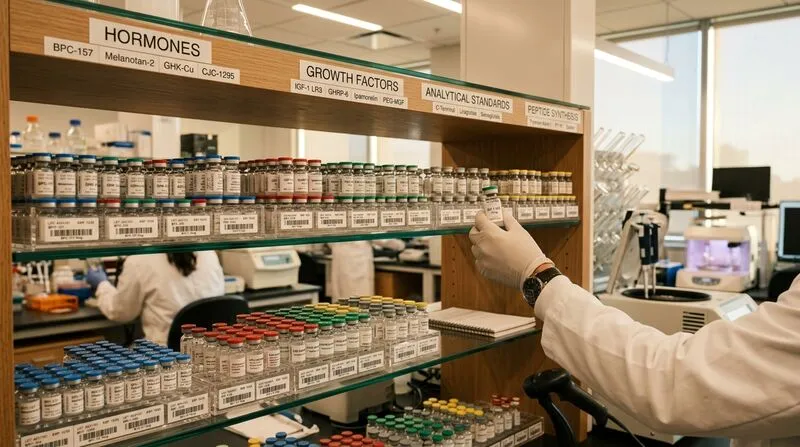
Quick answer: 98% HPLC purity is the research standard minimum. The remaining 2% can include synthesis byproducts, counterions, or degradation fragments — all of which matter for research integrity but are tolerable at that level. Below 95%, the impurity profile becomes a confounding variable in most protocols.
Purity percentages in peptide chemistry have specific technical meanings that are worth understanding before evaluating supplier CoAs. When a supplier reports "98% purity," they mean that 98% of the area under the HPLC chromatogram peak belongs to the target compound — the remaining 2% represents detectable impurities.
HPLC: What It Measures and What It Doesn't
High-performance liquid chromatography separates compounds by differential affinity for a stationary phase. The resulting chromatogram shows retention time on the x-axis and UV absorbance (signal intensity) on the y-axis. The area under each peak represents the relative proportion of that compound in the sample.
HPLC is excellent at measuring purity — the relative proportion of your target compound versus detectable impurities. What it cannot do alone is confirm identity. A peptide fragment with identical mass could co-elute at the same retention time as your target compound. This is why mass spectrometry is the required complement.
Mass Spectrometry: The Identity Confirmation Layer
Mass spectrometry determines molecular mass with high precision — typically within a few daltons for peptide compounds. When a CoA reports "Observed M+H: 1215.7 Da, Expected: 1215.6 Da," that's a match that confirms the compound's identity independent of purity.
The combination — HPLC for purity percentage, MS for identity confirmation — constitutes the minimum analytical standard for research-grade peptides. Either alone is insufficient. Both together give you high confidence that what's in the vial is what the label claims, at the stated purity level.
The 95% Floor
Below 95% HPLC purity, impurity levels begin to become significant confounding variables in most research protocols. If you're running dose-response experiments or observing biochemical effects, an impurity profile at 5% or above introduces uncertainty that's difficult to control for. 98%+ is the accepted standard for structured research for exactly this reason.
Some suppliers list "≥95%" as their specification rather than "≥98%." This lower threshold may be acceptable for certain preliminary or exploratory applications, but it shouldn't be accepted as equivalent to the higher standard. Understand what you're buying and why the specification is set where it is.
Third-Party Verification: The Janoshik Standard
Quick answer: Janoshik Analytical is the de facto independent testing standard in the research peptide space. Their key advantage over other labs isn't just technical capability — it's the publicly searchable submission database that makes their results independently verifiable without contacting the supplier.
Third-party testing is only valuable if the third party is genuinely independent and the results are verifiable. This is where Janoshik stands apart from the proliferation of "independent lab" claims in the market.
Who Is Janoshik?
Janoshik Analytical is a Czech Republic-based laboratory that has built its reputation specifically on serving the research compound community. They offer HPLC and mass spectrometry analysis with a turnaround time that makes batch testing economically viable for suppliers at scale. More importantly, they maintain a public results database at janoshik.com where any submitted sample's results can be searched by submission number.
This matters because it closes the primary fraud vector. A supplier could fabricate an in-house CoA. They could even fabricate a document that looks like a Janoshik report. What they cannot easily do is create a verifiable entry in the Janoshik database that matches the report they've provided to you.
How to Verify a Janoshik CoA
The process takes about 90 seconds. Take the submission or sample number from the CoA provided by the supplier. Go to janoshik.com and enter the submission number in the search field. The result should display the same compound name, purity figure, and analysis date as the CoA document. If it doesn't exist, or the results don't match, the document is fabricated.
Not every Janoshik batch is publicly searchable — some clients opt for private submissions. But the best suppliers make their results publicly searchable as a deliberate transparency measure. If a supplier claims Janoshik testing but directs you only to their own website for CoA access, ask them specifically for a publicly searchable submission number.
Other Credible Testing Laboratories
Janoshik is the most widely cited, but it isn't the only credible option. Several accredited analytical chemistry laboratories accept contract peptide testing — the key requirements are ISO 17025 accreditation or equivalent, documented HPLC instrumentation specifications, and a process for independent result verification. US-based alternatives include Cayman Chemical (which also sells compounds but tests third-party samples) and various academic-affiliated analytical service laboratories.
Anatomy of a Valid Certificate of Analysis
Quick answer: A valid CoA for research peptides contains eight specific data points. If any of the first four are missing, the document should be treated as analytically insufficient.
After reviewing CoA documents from over 30 suppliers during the research for this guide, the variation in quality is staggering. Some documents are genuinely excellent — instrument-specific, batch-referenced, with full spectral data. Others are one-page PDFs with a compound name and a percentage that provide essentially no useful information.
| CoA Element | Why It Matters | Required? |
|---|---|---|
| Batch / Lot Number | Links the document to a specific production run — not generic | Critical |
| Analysis Date | Confirms the data is current — dated documents may not reflect current stock | Critical |
| HPLC Purity % | The actual purity figure with peak area method specified | Critical |
| MS Molecular Weight | Observed vs. expected mass — confirms compound identity | Critical |
| Testing Laboratory Name | Enables independent verification of the testing entity | Critical |
| Instrument Specification | Column type, mobile phase, flow rate — confirms methodology | High |
| Chromatogram Image | Visual representation of peak separation and purity | High |
| Submission Reference | Verifiable in lab database (Janoshik: publicly searchable) | High |
The UNIK LAB CoA standard includes all eight elements per batch. See our Certificate of Analysis format for a reference example of what full analytical documentation looks like.
The Chromatogram: Reading What It Shows
Many researchers receive HPLC chromatograms but aren't sure what to look for. The critical elements are simple: one dominant peak representing your target compound, with the peak area percentage reported beneath it, and any minor peaks clearly identified or acknowledged as trace impurities below the quantification limit. A clean chromatogram for a 98%+ compound should be visually dominated by a single peak with minimal secondary signals.
Red flags in chromatograms: multiple peaks of similar height (indicates significant impurity), baseline drift (can mask impurities), or a peak area percentage that doesn't match the stated purity figure in the summary section.
Shipping Zones and Customs Realities
Quick answer: Jurisdiction matching — sourcing from a supplier in or near your country — is the single most reliable predictor of shipping success. Transatlantic shipments have a documented failure rate that's often understated in supplier marketing.
Peptide Sciences was a US-based operation. For US researchers, this was a significant advantage — domestic shipping, predictable transit times, no customs scrutiny. For UK and EU researchers, it was consistently the weakest link. Post-Brexit customs changes created additional friction for UK-destined shipments. Many EU researchers reported delays of 2-6 weeks or outright seizures.
UK Researchers
The most reliable sourcing route for UK-based researchers is now a UK-native supplier. This eliminates import duties, customs inspection risk, and transit time uncertainty. UNIK LAB ships domestically within the UK with standard courier services. Direct Peptides is another UK-based option. Domestic sourcing should be the default for UK researchers going forward.
EU Researchers
Intra-EU shipping benefits from free movement of goods. A supplier based in Germany, the Netherlands, or the Czech Republic ships domestically to any EU country with minimal friction. UK-based suppliers can ship to the EU but are now technically subject to customs checks at the UK-EU border — though in practice, research reagents below certain value thresholds rarely face issues. US-to-EU shipping carries significantly higher interception risk.
US Researchers
The post-Peptide Sciences US market still has several established domestic suppliers. The FDA's current enforcement posture doesn't generally target personal research quantities of peptide compounds when sold with appropriate research-use-only documentation, though the regulatory environment continues to evolve. Shipping from UK or EU to US is technically possible and some UK suppliers do this reliably, but customs timelines are less predictable than domestic sourcing.
Packaging and Cold Chain
Lyophilised (freeze-dried) peptides are stable at ambient temperature for the duration of most shipping windows — typically 1-5 days domestically, up to 10-14 days internationally. Reconstituted peptides are not shipping-stable and should never arrive pre-mixed. If a supplier ships liquid pre-mixed peptide solutions, that's a red flag for both stability and regulatory compliance.
Bacteriostatic water for reconstitution can be ordered separately and doesn't face the same shipping complexities as the peptides themselves.
Payment Methods and What They Signal
Quick answer: Cryptocurrency-only suppliers are a yellow flag, not necessarily a red one — but the inability to accept any traditional payment method indicates either merchant account difficulties (often for compliance reasons) or a preference for non-reversible transactions that should be noted.
Payment infrastructure is a surprisingly informative signal about a supplier's legitimacy and longevity. Getting and keeping merchant processing accounts requires bank relationships that involve identity verification, business registration, and compliance review. Suppliers with these accounts have passed at least baseline scrutiny.
Credit Cards and Chargeback Rights
The strongest consumer protection in online commerce is the credit card chargeback. If a supplier fails to deliver, delivers the wrong product, or closes without fulfilling orders (as happened with Peptide Sciences for many customers), credit card chargebacks within the dispute window are often the only effective recovery mechanism. Suppliers that accept major credit cards through legitimate processors are implicitly accepting this accountability structure.
Cryptocurrency Payments
Some established and reputable suppliers accept cryptocurrency — often because merchant accounts are difficult to obtain in the research compounds space, not because they're trying to avoid accountability. The absence of chargeback rights, however, means that validation becomes more critical before ordering. Start with small test orders from crypto-only suppliers regardless of reputation.
Wire Transfer / ACH Only
Suppliers that accept only wire transfers or ACH payments, with no card or crypto options, occupy an unusual position. Wire transfers are irreversible and provide even less consumer protection than cryptocurrency. This payment structure should raise caution and warrants additional due diligence on the supplier's analytical documentation and community reputation.
The Complete Supplier Evaluation Checklist
Quick answer: Run every new supplier through this checklist before placing a first order. The scoring below is cumulative — a supplier needs to pass the Critical criteria and at least 3 of the High criteria to be considered for research use.
Honestly, the data speaks for itself when you apply a systematic framework. Suppliers that can't satisfy the critical criteria below rarely improve upon investigation — they tend to perform worse. Suppliers that meet all criteria consistently tend to also deliver on less quantifiable dimensions like communication quality and order accuracy.
Supplier Evaluation Checklist — April 2026
Current Credible Suppliers (April 2026)
Quick answer: The following suppliers have been assessed against the checklist above. All pass the critical criteria. None are presented as perfect; the weaknesses are listed alongside the strengths because that's what a research sourcing decision requires.
UNIK LAB — UK/EU/US
UK-based, Janoshik CoA per batch, HPLC ≥98% with MS confirmation. Domestic UK shipping, EU shipping with minimal customs exposure, and US international shipping available. Catalogue covers the most in-demand research peptide categories. Strict research-use-only positioning. Limitation: catalogue is still growing — some less common compounds may not be listed but can be enquired about. Browse the current compound catalogue.
Limitless Life Nootropics — US
One of the longest-established remaining US suppliers. Strong analytical track record with documented Janoshik partnerships. Large catalogue including GH peptides, anti-aging compounds, and cognitive research reagents. Weakness: EU/UK shipping is unreliable in practice — suitable primarily for US researchers.
Direct Peptides — UK
UK-native supplier with solid Janoshik documentation. Good EU shipping. Narrower catalogue than Limitless or UNIK LAB, and support response times can be slow. Better suited for UK/EU researchers sourcing specific compounds from a focused catalogue.
Amino Asylum — US
Large US community following, fast domestic shipping, competitive pricing. CoA consistency is the concern — some batches are well-documented, others revert to less rigorous in-house testing. Run the checklist carefully per specific batch before ordering for sensitive protocols. Not recommended for EU/UK researchers due to shipping unreliability.
Building a Resilient Sourcing Strategy
Quick answer: Single-supplier dependency is the root cause of why Peptide Sciences' closure was so disruptive. The resilient approach uses 2-3 verified suppliers across different jurisdictions, with validated small orders established before you need the supply.
The lesson from Peptide Sciences is structural, not just about that specific company. No supplier — regardless of scale or reputation — should be the sole source for research compounds that active protocols depend on. The pharmaceutical sciences world figured this out decades ago; the research peptide community is catching up.
The Two-Supplier Minimum
For any compound used in an active research protocol, identify and validate at least two suppliers before you need them. This means placing small validation orders, reviewing the CoA documentation from each, and confirming delivery reliability to your location — all while your primary supply is still adequate. Don't wait until you're out of stock to discover that Supplier B has a 3-week backorder on the compound you need.
Stock Management for Research Labs
Lyophilised peptides stored at -20°C maintain integrity for 12-24 months. There's no research rationale for maintaining only 30 days of supply when maintaining 3-6 months costs a small fraction of the total research budget and eliminates supply chain risk entirely. Adjust your ordering cadence to match your actual research timeline, not a just-in-time purchasing model that works fine for commodity goods but poorly for research reagents.
Community Intelligence
Forums like Reddit's r/Peptides represent thousands of hours of collective quality verification that no single researcher could replicate. Community reports on specific batches from specific suppliers are one of the most valuable sourcing intelligence resources available. Use them — but weight recent reports (within 3 months) more heavily than historical reputation, because supplier quality can and does change.
Frequently Asked Questions
Where can I buy research peptides now that Peptide Sciences has closed?
Several credible suppliers remain operational as of April 2026. UNIK LAB serves UK, EU, and US researchers with full Janoshik CoA documentation per batch. Limitless Life Nootropics is the strongest US-based alternative for domestic US sourcing. Direct Peptides is a solid UK-based option. Apply the evaluation checklist from this guide before committing to any supplier — the market has attracted opportunistic operators following the Peptide Sciences closure.
What purity should research peptides be?
Research-grade peptides should meet ≥98% HPLC purity, confirmed by batch-specific chromatographic data and mass spectrometry identity verification. Below 95%, impurity levels become a meaningful confounding variable in most research protocols. Generic purity claims without batch-specific data are analytically insufficient.
What is Janoshik and why does it matter?
Janoshik Analytical is a Czech-based independent laboratory providing HPLC and mass spectrometry testing for research compounds. Their critical differentiator is a publicly searchable submission database that allows researchers to independently verify any reported result by cross-referencing the submission number. This makes their CoAs far more credible than in-house or non-verifiable third-party testing.
Can I buy research peptides in the UK or EU?
Yes. Several UK and EU-native suppliers operate with domestic or intra-EU shipping, eliminating transatlantic customs risk. UNIK LAB ships domestically within the UK and to EU countries. Research peptides sourced for scientific use are a legitimate research reagent category in these jurisdictions when sold with appropriate research-use-only documentation.
How do I evaluate a research peptide supplier I haven't used before?
Use the six-point framework: batch-specific HPLC purity ≥98%, mass spectrometry identity confirmation, independent third-party lab (Janoshik or equivalent), shipping success to your jurisdiction, sufficient catalogue breadth, and responsive scientific support. Order a small validation batch before committing your full research budget. Check community forums for recent batch-specific reports.
Research Supply — UK / EU / US
UNIK LAB Research Catalogue
Janoshik third-party CoA per batch. HPLC ≥98% + mass spectrometry. Research use only.