HPLC Verified
Purity confirmed by High-Performance Liquid Chromatography at an accredited EU laboratory.
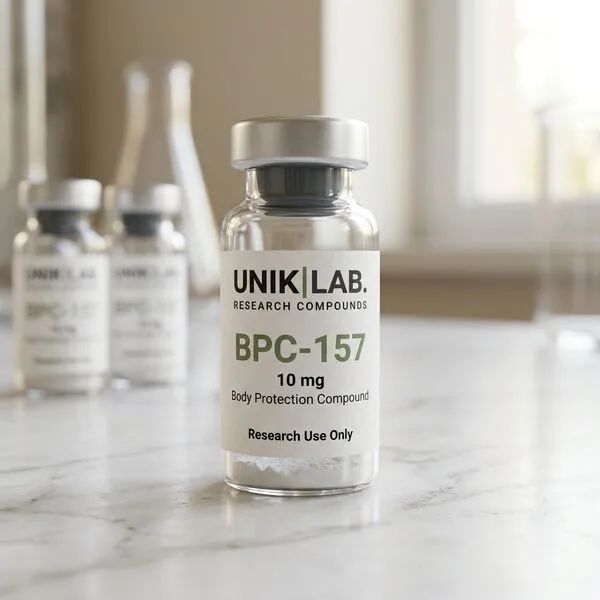
10mg recovery research peptide
BPC-157 — full designation Body Protection Compound-157 — is a synthetic pentadecapeptide of fifteen amino acids, its sequence a partial excerpt of the Body Protection Compound isolated from human gastric juice. Since its first characterisation in the early 1990s, it has accumulated one of the most extensive preclinical dossiers in peptide science.
The parent protein from which BPC-157 is derived is found in the protective lining of the gastric mucosa, a tissue subject to perpetual chemical insult. Researchers originally identified it while investigating endogenous mechanisms that allow stomach epithelium to withstand acid and enzymatic degradation. The synthetic fifteen-residue fragment — Pro-Pro-Pro-Pro-Pro-Pro-Gly-Glu-Pro-Pro-Pro-Pro-Pro-Gly-Lys — proved to be both stable and highly active in isolation, surviving the proteolytic environment that destroys most natural peptides.
Preclinical investigation has pointed toward BPC-157 engaging multiple signalling cascades simultaneously. Studies in rodent models have documented interactions with the nitric oxide (NO) system, where the compound appears to modulate eNOS expression and downstream vascular tone. Of particular interest to connective tissue researchers is its apparent influence on growth factor receptor pathways: work by Sikiric and colleagues identified upregulation of VEGFR2 and FGFR in tendon fibroblasts, suggesting a role in vascular and structural remodelling at sites of injury.
Parallel work in gastrointestinal research has explored BPC-157's interaction with the dopaminergic and serotonergic systems, as well as its apparent capacity to modulate prostaglandin synthesis — findings that have informed mechanistic models of its cytoprotective activity.
The preclinical literature on BPC-157 spans several distinct biological territories. Musculoskeletal research has examined healing dynamics in transected Achilles tendons, severed quadriceps, and rotator cuff injury models, consistently reporting accelerated restoration of biomechanical integrity. Gastrointestinal research has explored its protective effects across a range of mucosal insult models, from NSAID-induced damage to stress-induced ulceration. Neurological studies have investigated modulation of glutamate-mediated excitotoxicity and dopamine system function in rodent preparations.
A notable feature of the existing literature is the compound's apparent stability across administration routes — subcutaneous, intragastric, and intraperitoneal — a characteristic that has made it a practical tool for in vivo study design.
Despite its substantial preclinical footprint, BPC-157 remains a research compound without regulatory approval for human use. All studies cited in the scientific literature were conducted under controlled laboratory conditions using animal models or in vitro cell cultures. Researchers working with BPC-157 are advised to consult the most current primary literature and to operate within applicable institutional and regulatory frameworks.
This content is for informational purposes only and reflects the state of preclinical research. It does not constitute medical advice, endorsement of human use, or therapeutic claims of any kind.
Purity confirmed by High-Performance Liquid Chromatography at an accredited EU laboratory.
Every batch meets or exceeds 98% purity. CoA available for verification before dispatch.
Each vial is traceable to its synthesis batch, testing date, and analytical records.
European stock stored at optimal temperature from synthesis to dispatch.
Orders ship from EU stock within 48 hours with discrete, temperature-appropriate packaging.
Certificate of Analysis issued for every batch, available for download on request.
Peer-reviewed research supporting Body Protection Compound-157 investigation.
This comprehensive review synthesises over two decades of preclinical data on BPC-157 across gastrointestinal and musculoskeletal applications. Authors document consistent cytoprotective effects in mucosal injury models and propose mechanistic links to the NO-system and growth factor receptor modulation.
View on PubMedA systematic examination of BPC-157's effects on tendon, ligament, and muscle repair in rodent models. The authors report significant improvements in biomechanical tensile strength and histological markers of organised collagen deposition at treated injury sites relative to controls.
View on PubMedIn vitro work demonstrating BPC-157's capacity to enhance tendon fibroblast proliferation, migration, and survival following serum deprivation. The study identifies dose-dependent upregulation of F-actin cytoskeletal organisation and FAK/paxillin signalling, providing a cellular basis for observed in vivo healing effects.
View on PubMedA conceptual and experimental review reframing BPC-157's activity within a broader cytoprotective paradigm. The paper argues for an integrated model incorporating vascular, neural, and inflammatory pathway modulation, supported by data from ulcer, liver, and brain injury models.
View on PubMedInvestigation into BPC-157's effects on dopaminergic pathways using a 6-hydroxydopamine lesion rodent model. The study reports partial functional recovery in motor performance correlated with changes in dopamine metabolite ratios, suggesting interaction with central catecholaminergic circuitry.
View on PubMedAll studies referenced are independent third-party research. UNIK LAB makes no claims regarding the therapeutic efficacy of any compound and does not represent or endorse the conclusions of cited studies. All referenced research was conducted under controlled laboratory or clinical conditions; results may not be predictive of effects in other experimental contexts.
Answers to the most frequently asked questions about Body Protection Compound-157.
Other Recovery research compounds from our catalogue.
BPC-157 is a synthetic fifteen-residue peptide derived from the cytoprotective protein of the human gastric mucosa. Its proline-rich sequence confers exceptional metabolic stability, allowing the peptide to remain active in proteolytic environments that rapidly degrade most natural peptides.
Preclinical studies document BPC-157 interaction with the eNOS/NO signalling axis, with observed upregulation of VEGFR2 in tendon fibroblasts. These vascular effects are proposed as a primary mechanistic contributor to angiogenic and tissue-remodelling activity observed across multiple injury models.
BPC-157 demonstrates consistent gastroprotective activity across NSAID-induced, stress-induced, and ethanol-induced mucosal injury models in rodents. Proposed mechanisms include prostaglandin synthesis modulation and direct cytoprotective signalling in gastric epithelial cells.
A substantial body of preclinical work documents accelerated biomechanical recovery in transected Achilles tendon, quadriceps, and rotator cuff models. Cellular studies report enhanced fibroblast migration via FAK/paxillin signalling and organised collagen deposition at repair sites.
BPC-157 has been studied in models of dopaminergic and serotonergic dysfunction, including the 6-OHDA lesion model. Studies report partial functional recovery in motor performance correlated with changes in dopamine metabolite ratios, suggesting interaction with central catecholaminergic circuitry.
BPC-157 (Body Protection Compound-157) is a synthetic pentadecapeptide — a chain of fifteen amino acids — derived from a naturally occurring protein in human gastric juice. It is classified as a research compound and has not received regulatory approval for human or veterinary therapeutic use. All available data originate from preclinical studies in animal models or cell culture systems.
UNIK LAB's BPC-157 achieves ≥98% purity as verified by High-Performance Liquid Chromatography (HPLC) and confirmed via LC-MS for molecular identity. Each batch is accompanied by a Certificate of Analysis detailing the analytical methodology, retention time data, and batch-specific purity percentage. Our manufacturing partner operates under EU GMP-equivalent standards.
Lyophilised BPC-157 should be stored at 2–8°C in a dry, light-protected environment for long-term stability (up to 24 months). For working stocks used within 4 weeks, refrigeration at 2–8°C is acceptable. Once reconstituted in bacteriostatic water, the resulting solution should be stored at 2–8°C in a sealed vial and used within 28 days. Repeated freeze-thaw cycles should be avoided.
Each CoA issued for BPC-157 includes: HPLC chromatogram with purity percentage, LC-MS spectrum confirming molecular weight of 1,419.56 Da, amino acid sequence verification where applicable, batch number for full traceability, manufacturing date and expiry date, and the name and accreditation number of the testing laboratory. CoAs are available to download on our Certificate of Analysis page.
The preclinical literature encompasses gastrointestinal (mucosal injury, ulceration, inflammatory bowel models), musculoskeletal (tendon, ligament, muscle, and bone repair models), neurological (dopaminergic and serotonergic system studies, traumatic brain injury models), and vascular systems. The majority of studies have been conducted by the University of Zagreb group and replicated by independent laboratories across Europe and North America.
In most EU jurisdictions, BPC-157 is not a controlled substance and may be purchased legally for in vitro and preclinical research purposes by qualified researchers. It is not approved as a medicinal product in any jurisdiction. Researchers are responsible for ensuring compliance with their institution's ethics frameworks and applicable national regulations governing research compounds.
For cell culture work, BPC-157 is typically reconstituted in sterile bacteriostatic water or phosphate-buffered saline (PBS) at a stock concentration of 1–10 mg/mL, then serially diluted in the appropriate cell culture medium to working concentrations. Sterile filtration (0.22 µm) of the reconstituted solution is recommended before addition to cell cultures. Consultation of primary literature for assay-specific concentrations is advised.
The most extensively studied mechanism involves the nitric oxide (NO) signalling pathway, specifically eNOS upregulation and VEGFR2 modulation in vascular and connective tissue models. A second major area of investigation involves the FAK-paxillin pathway in fibroblast migration and cytoskeletal reorganisation. Both mechanisms have been proposed as contributors to the healing dynamics observed across multiple tissue types in preclinical studies.