HPLC Verified
Purity confirmed by High-Performance Liquid Chromatography at an accredited EU laboratory.
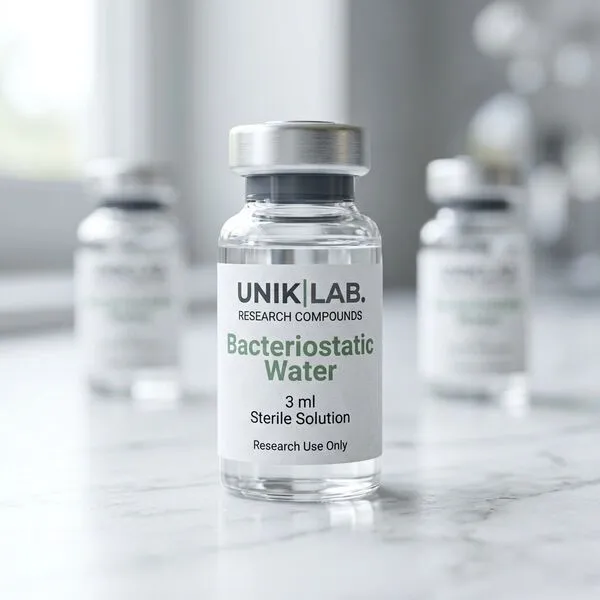
3ml sterile reconstitution solution
Bacteriostatic water is sterile water for injection preserved with 0.9% benzyl alcohol — the industry-standard solvent for reconstitution of lyophilised research peptides and proteins. Its formulation is designed to balance the stability and solubility requirements of reconstituted peptides with preservation of sterility during multi-dose use in laboratory settings.
Lyophilised peptides require aqueous reconstitution for any experimental use involving liquid-phase application: in vitro cell culture assays, in vivo injection studies, or HPLC verification of reconstituted material. The selection of appropriate reconstitution solvent is a critical experimental variable. Bacteriostatic water is the preferred solvent for most research peptides for three reasons: the 0.9% benzyl alcohol preservative inhibits bacterial growth during multi-use withdrawal over days to weeks; the neutral pH and low ionic strength avoids disruption of peptide folding or aggregation; and its defined composition allows precise volumetric calculation of reconstituted peptide concentration.
Benzyl alcohol acts as a bacteriostatic preservative by disrupting bacterial cell membrane integrity and inhibiting metabolic enzyme activity at bacteriostatic concentrations (0.9–1.0% v/v). At this concentration it does not appreciably affect peptide structure or activity in most research contexts. It should be noted that benzyl alcohol at higher concentrations can be cytotoxic; researchers performing in vitro cell assays should verify that the final concentration of benzyl alcohol in cell culture medium following peptide addition remains below cytotoxic thresholds (typically <0.01%).
UNIK LAB's bacteriostatic water is supplied as a sterile, filtered (0.22 µm) solution in 3 ml pharmaceutical-grade vials with sealed rubber stoppers compatible with standard research syringes. pH is adjusted to 4.5–7.0 for optimal compatibility across the majority of research peptides. The solution is endotoxin-tested and manufactured to USP/Ph.Eur. standards for water for injection as the base fluid.
For laboratory research use only. Not for direct infusion or therapeutic use. Always consult primary literature for peptide-specific reconstitution protocols and verify compatibility with your experimental system.
Purity confirmed by High-Performance Liquid Chromatography at an accredited EU laboratory.
Every batch meets or exceeds 98% purity. CoA available for verification before dispatch.
Each vial is traceable to its synthesis batch, testing date, and analytical records.
European stock stored at optimal temperature from synthesis to dispatch.
Orders ship from EU stock within 48 hours with discrete, temperature-appropriate packaging.
Certificate of Analysis issued for every batch, available for download on request.
Answers to the most frequently asked questions about Bacteriostatic Water.
Bacteriostatic water is sterile water for injection containing 0.9% benzyl alcohol as a preservative. The benzyl alcohol inhibits bacterial growth, enabling safe multi-dose use from a single vial over days to weeks when proper aseptic technique is maintained. Sterile water for injection (without preservative) must be used within a single session once opened, as it offers no protection against contamination after the stopper is punctured.
Sterile saline (0.9% NaCl) can be used for some peptides, but the ionic strength of saline may promote aggregation of certain peptides at higher concentrations. Bacteriostatic water's lower ionic strength and neutral character make it more universally compatible across the range of research peptides. Additionally, some peptides are pH-sensitive and reconstitution pH may be more readily adjusted in bacteriostatic water than in a buffered saline solution.
Reconstitution volume depends on the desired working stock concentration and is specific to each experimental protocol. A common starting approach for research purposes is to add volume sufficient to achieve a 1–5 mg/mL stock solution (e.g., adding 1 mL to a 2 mg vial for a 2 mg/mL stock). Researchers should consult the primary literature for peptide-specific reconstitution guidance and verify that the final working concentration in their experimental system is appropriate for their assay.
Unopened vials should be stored at room temperature (15–25°C) or under refrigeration (2–8°C), protected from freezing. Once punctured, store at 2–8°C. The 0.9% benzyl alcohol preservative maintains sterility for multi-use withdrawal for up to 28 days after first use, provided aseptic technique (alcohol-wiped stopper, sterile needle per entry) is maintained throughout.
Benzyl alcohol at the concentrations present in bacteriostatic water (0.9%) can be cytotoxic to mammalian cells. For in vitro cell culture applications, researchers must ensure that the final concentration of benzyl alcohol in the culture medium is below cytotoxic thresholds — typically below 0.01% (100 µg/mL). At a 1 mg/mL peptide stock in bacteriostatic water, a 1:1000 dilution in medium would yield a benzyl alcohol concentration of approximately 0.0009%, well within the safe range for most cell types.
Each UNIK LAB bacteriostatic water vial contains 3 mL of sterile 0.9% benzyl alcohol solution. This volume is sufficient to reconstitute multiple research peptide vials depending on the target stock concentration. The pharmaceutical-grade rubber stopper accepts standard 21–27 gauge needles and the vial remains sterile for multi-use withdrawal over the 28-day post-puncture window.
Bacteriostatic water is compatible with the majority of research peptides in the UNIK LAB catalogue, including BPC-157, GHK-Cu, Epitalon, Ipamorelin, CJC-1295 no DAC, Tesamorelin, and MOTS-c. For larger or more hydrophobic peptides, a small percentage of acetic acid (0.1–1% in water) may improve initial solubility before dilution in bacteriostatic water. Researchers should consult solubility data in the CoA or primary literature for peptide-specific guidance.