HPLC Verified
Purity confirmed by High-Performance Liquid Chromatography at an accredited EU laboratory.
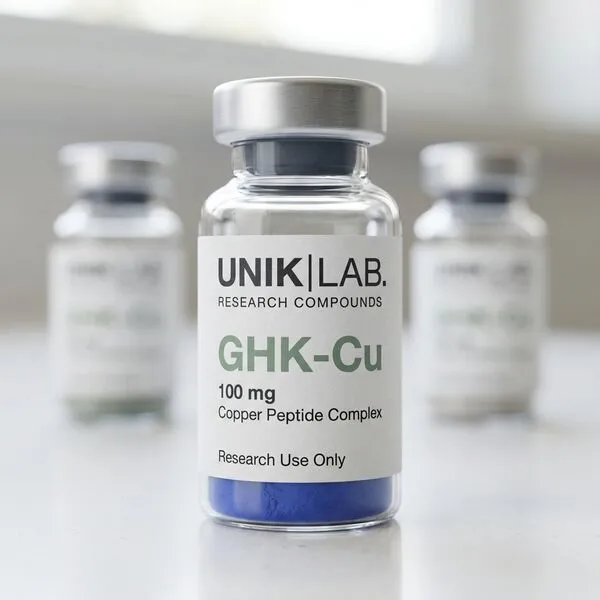
100mg copper tripeptide research compound
GHK-Cu — glycyl-L-histidyl-L-lysine complexed with copper(II) — is among the most intensively studied naturally occurring tripeptides in human biology. First isolated from human plasma in 1973 by Loren Pickart, its discovery preceded by decades the understanding of how such small peptides could exert such profound effects on tissue physiology.
What distinguishes GHK-Cu from most bioactive peptides is not its size — at three amino acids it is among the smallest structurally active peptides known — but the breadth of biological processes it appears to influence. Genome-wide transcriptional analysis performed by Pickart and colleagues identified GHK-Cu as a modulator of over 4,000 human genes, with significant enrichment in pathways governing tissue remodelling, inflammatory resolution, antioxidant defence, and neurological maintenance. This transcriptional footprint, documented across multiple independent microarray studies, has made GHK-Cu a subject of sustained interest across dermatology, wound healing biology, and geroscience.
The tripeptide's biological activity is intimately linked to its ability to chelate copper(II) ions with high affinity. This copper coordination complex appears to be the active species in many of the compound's observed effects. Copper is a redox-active metal essential for the function of superoxide dismutase, lysyl oxidase (critical for collagen and elastin cross-linking), and several components of the mitochondrial electron transport chain. GHK-Cu is proposed to function as a biological chaperone, facilitating copper delivery to these enzymatic systems while simultaneously influencing gene expression through less fully characterised direct mechanisms.
A large body of cell culture and animal model work has examined GHK-Cu's effects on fibroblast activity and extracellular matrix production. Studies report stimulation of collagen type I and III synthesis, upregulation of fibronectin and glycosaminoglycan production, and increased expression of tissue inhibitors of metalloproteinases (TIMPs) — collectively suggesting a pro-remodelling phenotype rather than simple collagen overproduction. Simultaneously, GHK-Cu has been shown to stimulate MMP-2 expression, implying a role in the dynamic remodelling of existing matrix architecture.
Bioinformatic analysis of GHK-Cu's transcriptional effects has revealed striking overlap with gene sets inversely correlated with biological ageing. Datasets from the Broad Institute's Connectivity Map project positioned GHK-Cu among the top compounds for reversing the molecular signature of cellular senescence in tissue culture models. This has attracted interest from researchers exploring the biology of cellular ageing, though it bears emphasis that such observations remain confined to in vitro systems and require substantial validation in physiologically relevant models.
This content is for informational purposes only and reflects the state of preclinical research. It does not constitute medical advice, endorsement of human use, or therapeutic claims of any kind.
Purity confirmed by High-Performance Liquid Chromatography at an accredited EU laboratory.
Every batch meets or exceeds 98% purity. CoA available for verification before dispatch.
Each vial is traceable to its synthesis batch, testing date, and analytical records.
European stock stored at optimal temperature from synthesis to dispatch.
Orders ship from EU stock within 48 hours with discrete, temperature-appropriate packaging.
Certificate of Analysis issued for every batch, available for download on request.
Peer-reviewed research supporting GHK-Cu investigation.
A systematic review of GHK-Cu's known biological activities, synthesising evidence from transcriptomic analyses, cell culture models, and animal studies. The authors document effects across collagen synthesis, antioxidant gene expression, anti-inflammatory signalling, and stem cell recruitment pathways, providing a comprehensive mechanistic framework for the compound's observed activities.
View on PubMedUpdate to the GHK-Cu research programme incorporating genome-wide expression data. Analysis of 4,000+ modulated genes reveals enrichment in pathways governing tissue repair, inflammation resolution, and nerve growth factor signalling. The authors propose a systems-level model for GHK-Cu action beyond individual target modulation.
View on PubMedA mechanistic review of copper's roles in skin biology, contextualising GHK-Cu within the broader framework of copper-dependent enzymatic activity. Key discussions centre on lysyl oxidase-mediated cross-linking, superoxide dismutase function, and the role of controlled copper delivery in supporting structural protein biosynthesis.
View on PubMedA focused review examining GHK-Cu through the lens of ageing biology. The authors assess the compound's capacity to modulate FOXO transcription factors, reduce lipid peroxidation, and restore expression of DNA repair genes in senescent cell models, positioning it within the emerging landscape of peptide-based geroscience tools.
View on PubMedAll studies referenced are independent third-party research. UNIK LAB makes no claims regarding the therapeutic efficacy of any compound and does not represent or endorse the conclusions of cited studies. All referenced research was conducted under controlled laboratory or clinical conditions; results may not be predictive of effects in other experimental contexts.
Answers to the most frequently asked questions about GHK-Cu.
Other Anti-Aging research compounds from our catalogue.
GHK-Cu forms a high-affinity coordination complex with copper(II) ions, with a dissociation constant in the picomolar range. The complex acts as a biological copper chaperone, facilitating copper delivery to lysyl oxidase, superoxide dismutase, and mitochondrial electron transport chain components.
Microarray and RNA-seq analyses consistently identify GHK-Cu as a modulator of over 4,000 human genes, with enrichment in pathways governing extracellular matrix remodelling, inflammatory resolution, antioxidant defence, and neurotrophin signalling. This breadth of transcriptional influence is unique among tripeptides.
Cell culture studies report GHK-Cu stimulation of collagen type I and III synthesis, fibronectin and glycosaminoglycan upregulation, and balanced MMP-2/TIMP modulation in dermal fibroblasts. The compound appears to promote dynamic matrix remodelling rather than simple anabolic collagen accumulation.
GHK-Cu supports superoxide dismutase activity via copper delivery and upregulates antioxidant gene expression including FOXO pathway targets. Studies in wound and skin models document anti-inflammatory cytokine modulation consistent with inflammatory resolution signalling.
Excisional wound studies in rodents report accelerated re-epithelialisation, increased wound tensile strength, and improved collagen organisation following GHK-Cu administration. Proposed mechanisms include fibroblast migration stimulation, VEGF upregulation, and recruitment of tissue remodelling cells to the wound microenvironment.
GHK-Cu is a naturally occurring tripeptide-copper complex first isolated from human plasma albumin in 1973. It is also found in saliva and urine. Plasma concentrations in humans decline significantly with age — from approximately 200 ng/mL at age 20 to roughly 80 ng/mL by age 60 — a pattern that has made it a subject of interest in ageing biology research.
The tripeptide GHK forms a stable, high-affinity complex with copper(II) ions. In this complexed form, the molecule appears to serve as a biological copper chaperone, facilitating delivery of copper to copper-dependent enzymes including lysyl oxidase (essential for collagen and elastin cross-linking) and superoxide dismutase (a key antioxidant enzyme). Many of the transcriptional effects documented in research literature are attributed specifically to the GHK-Cu complex rather than the free peptide.
Microarray and RNA-seq analyses have consistently identified GHK-Cu as a modulator of a large and diverse set of human genes. Studies published by Pickart and colleagues report modulation of over 4,000 genes, with significant enrichment in pathways governing extracellular matrix remodelling, inflammatory resolution, antioxidant defence, neurotrophin signalling, and circadian rhythm regulation. This breadth of transcriptional influence has made GHK-Cu a frequent subject of bioinformatic investigation in ageing and tissue biology.
Lyophilised GHK-Cu powder should be stored at 2–8°C, protected from light and moisture, for long-term stability. At this temperature, material should remain stable for 18–24 months. For routine laboratory use, aliquots may be stored at 2–8°C for up to 4 weeks. GHK-Cu is soluble in water and standard aqueous buffers; reconstitution in sterile bacteriostatic water at 1–10 mg/mL is typical for in vitro work.
The compound has been studied across a diverse range of cell types including dermal fibroblasts (the most common model), keratinocytes, hepatocytes, neural progenitor cells, and various cancer cell lines. Most mechanistic work on extracellular matrix synthesis, MMP/TIMP regulation, and antioxidant gene expression has used primary human fibroblast cultures. Researchers should select cell models appropriate to their specific research question.
UNIK LAB's GHK-Cu achieves ≥98% purity by HPLC with LC-MS identity confirmation. The copper content of each batch is verified to ensure correct coordination stoichiometry. A Certificate of Analysis documenting all analytical results is available for each batch number. Our EU-based manufacturing partner maintains ISO-compliant QC processes for all research-grade peptides.
GHK-Cu is the most extensively researched of the copper peptides. Its specificity lies in the Gly-His-Lys sequence, which confers unusually high copper-binding affinity (Kd in the picomolar range) compared to shorter or non-histidine-containing copper peptides. This high-affinity coordination is thought to underpin its distinct biological activity profile relative to other copper-containing research compounds.
Yes, wound healing is one of the earliest and most replicated areas of GHK-Cu research. Studies in excisional wound models in rodents have reported accelerated re-epithelialisation, increased wound tensile strength, and improved organisation of collagen fibres at wound sites. The mechanisms proposed include stimulation of fibroblast migration and proliferation, upregulation of VEGF expression, and enhanced recruitment of tissue remodelling cells to the wound microenvironment.