HPLC Verified
Purity confirmed by High-Performance Liquid Chromatography at an accredited EU laboratory.
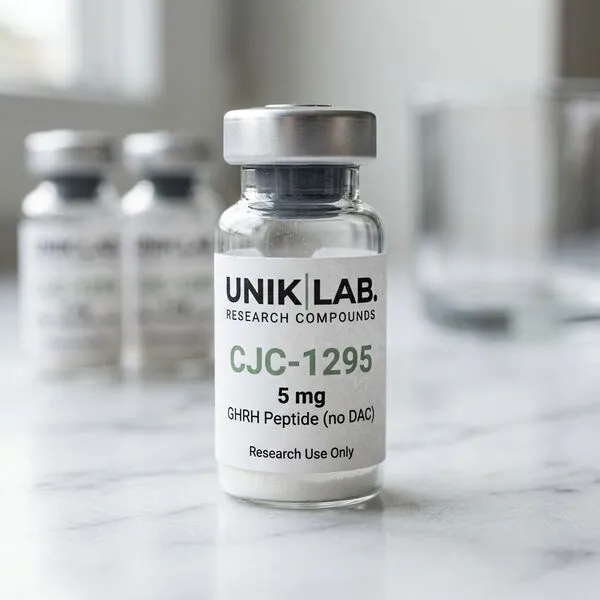
5mg GHRH research peptide
CJC-1295 without DAC — more precisely designated Modified GRF(1-29) or Mod GRF 1-29 — is a synthetically optimised derivative of the first twenty-nine amino acids of growth hormone-releasing hormone, incorporating four strategic amino acid substitutions that enhance metabolic stability while preserving full GHRH receptor (GHRHR) agonism. It represents the gold standard GHRH peptide tool for basic research into pulsatile GH secretion dynamics.
Native GHRH(1-29) contains the full biological activity of the complete 44-residue hormone within its first 29 amino acids — a finding that enabled the development of a series of truncated and modified analogues. The modifications in CJC-1295 no DAC address the key vulnerabilities of the native peptide: substitution at position 2 (Ala→D-Ala) prevents DPP-4 cleavage; substitution at position 8 (Asn→Gln) eliminates asparagine deamidation; position 15 (Gly→Ala) improves conformational stability; and position 27 (Met→Leu) removes the oxidation-sensitive methionine residue. The result is a GHRH fragment with a substantially improved pharmacokinetic profile relative to native GHRH(1-29) while maintaining complete receptor selectivity.
The "no DAC" designation is critical for understanding the compound's pharmacological character. CJC-1295 with DAC (Drug Affinity Complex) contains an additional lysine conjugated with a maleimide-derivatised fatty acid chain, enabling covalent binding to circulating albumin and dramatically extending plasma half-life to approximately 6–8 days. CJC-1295 no DAC lacks this modification, resulting in a plasma half-life comparable to other GHRH peptides (approximately 30 minutes), which produces a physiologically pulsatile GH secretory pattern rather than the sustained elevated GH levels produced by the DAC-containing version. For research applications requiring preserved pulse architecture of the GH axis, CJC-1295 no DAC is the pharmacologically appropriate choice.
CJC-1295 no DAC is used in research settings to acutely stimulate pituitary GH release, enabling study of somatotroph function, GH secretion kinetics, and downstream IGF-1 production in a manner that respects the endogenous pulsatile architecture of the GH axis. Combined with a growth hormone secretagogue (GHSR agonist such as ipamorelin), it can be used to study synergistic stimulation of the two converging inputs to pituitary GH secretion.
This content is for informational purposes only and reflects the state of preclinical research. It does not constitute medical advice, endorsement of human use, or therapeutic claims of any kind.
Purity confirmed by High-Performance Liquid Chromatography at an accredited EU laboratory.
Every batch meets or exceeds 98% purity. CoA available for verification before dispatch.
Each vial is traceable to its synthesis batch, testing date, and analytical records.
European stock stored at optimal temperature from synthesis to dispatch.
Orders ship from EU stock within 48 hours with discrete, temperature-appropriate packaging.
Certificate of Analysis issued for every batch, available for download on request.
Peer-reviewed research supporting CJC-1295 no DAC investigation.
Detailed pharmacodynamic characterisation of GHRH analogue effects on GH pulse architecture. The study demonstrates that GHRH analogue stimulation amplifies GH pulse amplitude while preserving the pulsatile pattern dependent on endogenous somatostatin oscillations — a finding with important implications for research into physiological versus pharmacological GH axis stimulation.
View on PubMedProteomic analysis of serum changes following GHRH analogue administration in healthy adult subjects. Beyond expected IGF-1 increases, the study identifies a broad set of plasma proteins altered by GH axis activation, providing a systems-level view of the downstream molecular consequences of GHRH receptor stimulation in humans.
View on PubMedGenetic characterisation study establishing a GHRH knockout mouse model — a critical tool for understanding the GHRH-GH-IGF-1 axis. The model demonstrates that GHRH is essential for normal somatotroph development and GH secretory capacity, providing a genetic validation for GHRH receptor pharmacology as a strategy for modulating GH axis activity.
View on PubMedAll studies referenced are independent third-party research. UNIK LAB makes no claims regarding the therapeutic efficacy of any compound and does not represent or endorse the conclusions of cited studies. All referenced research was conducted under controlled laboratory or clinical conditions; results may not be predictive of effects in other experimental contexts.
Answers to the most frequently asked questions about CJC-1295 no DAC.
Other Growth Hormone research compounds from our catalogue.
CJC-1295 no DAC incorporates four targeted amino acid substitutions (D-Ala2, Gln8, Ala15, Leu27) that collectively prevent DPP-4 cleavage, eliminate asparagine deamidation, improve conformational stability, and remove the oxidation-susceptible methionine residue — while maintaining complete GHRH receptor selectivity.
Without the DAC albumin-binding moiety, CJC-1295 no DAC has a short plasma half-life (~30 minutes) that produces acute pulsatile GH release rather than sustained elevation. This makes it the pharmacologically appropriate tool for research requiring preservation of the physiological GH pulse architecture.
GHRH receptor activation by CJC-1295 no DAC drives downstream hepatic IGF-1 production through the intact GH-IGF-1 axis. Proteomic analyses document a broad set of plasma proteins altered by GH axis activation, providing a systems-level view of GHRH receptor stimulation consequences.
As a well-characterised GHRHR agonist, CJC-1295 no DAC is a standard reference tool for pituitary somatotroph pharmacology research. Combined with GHSR agonists such as ipamorelin, it enables investigation of synergistic GH secretion from the two main physiological inputs to the pituitary somatotroph.
The key difference is plasma half-life and resulting GH secretion pattern. CJC-1295 with DAC contains a drug affinity complex (maleimide fatty acid) that enables covalent albumin binding, extending half-life to 6–8 days and producing sustained elevated GH levels. CJC-1295 without DAC (Mod GRF 1-29) has a short half-life (~30 minutes) and produces acute pulsatile GH release that mirrors the physiological GH secretion pattern. Research applications where the preservation of GH pulse architecture is important require the no-DAC version.
Each substitution addresses a specific chemical vulnerability of the native peptide: (1) D-Ala at position 2 prevents rapid N-terminal cleavage by DPP-4; (2) Gln at position 8 eliminates asparagine deamidation, a primary degradation route; (3) Ala at position 15 improves conformational stability; (4) Leu at position 27 removes the oxidation-susceptible methionine. Collectively, these changes extend metabolic stability without altering receptor selectivity or binding affinity at the GHRH receptor.
UNIK LAB's CJC-1295 no DAC achieves ≥98% purity by HPLC, with LC-MS identity confirmation verifying the molecular weight of 3,367.97 Da. The modified amino acids and absence of the DAC moiety are verified as part of molecular identity confirmation. Full CoA with analytical data and batch traceability is provided.
Primary pituitary somatotroph cell cultures are the most direct in vitro model for GHRH receptor pharmacology. Rat GH3 or GH4C1 pituitary tumour cells expressing GHRHR are used for higher-throughput cAMP and GH secretion assays. In vivo, intact or surgically modified rodent models (GHRH knockout, dwarf Ames or Snell mice) provide context for studying GH axis function and downstream metabolic phenotypes.
In preclinical research, CJC-1295 no DAC is frequently used in combination with growth hormone secretagogues (GHSRs/ghrelin receptor agonists such as ipamorelin) to study synergistic somatotroph stimulation. GHRH peptides and ghrelin-axis peptides act through distinct receptor systems that converge on somatotroph GH secretion; their combined use allows investigation of the relative and synergistic contributions of the two main physiological inputs to pulsatile GH release.
Store lyophilised CJC-1295 no DAC at 2–8°C in sealed vials, protected from light and moisture. The four amino acid modifications significantly improve stability relative to native GHRH(1-29), but cryogenic storage remains essential for long-term integrity. Reconstitute in sterile bacteriostatic water; aliquot reconstituted solution and store at 2–8°C for use within 21 days, or at 2–8°C for extended storage.