HPLC Verified
Purity confirmed by High-Performance Liquid Chromatography at an accredited EU laboratory.
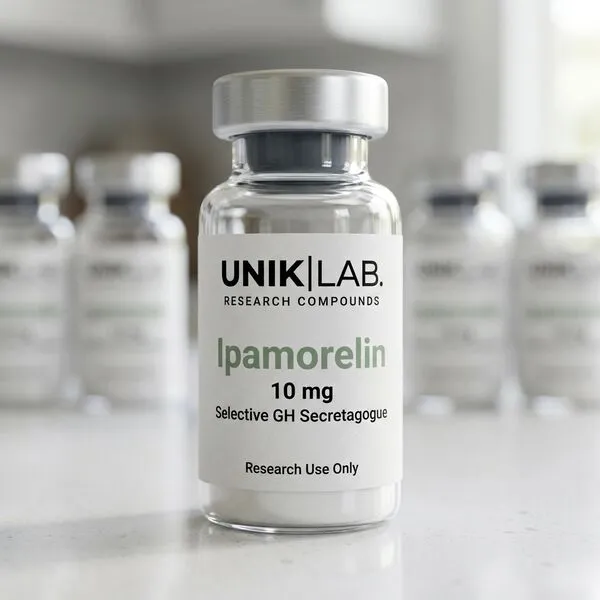
10mg selective GHS research peptide
Ipamorelin is a synthetic pentapeptide growth hormone secretagogue (GHS) — one of the most selective and well-characterised agonists of the growth hormone secretagogue receptor (GHSR-1a, the ghrelin receptor) available as a research tool. First reported by Raun and colleagues at Novo Nordisk in 1998, it was designed specifically to maximise GH-releasing potency while minimising the off-target effects that complicated earlier generation secretagogues.
The growth hormone secretagogue receptor (GHSR-1a) is a seven-transmembrane G protein-coupled receptor that is constitutively active and serves as the receptor for endogenous ghrelin. It is expressed highly on pituitary somatotrophs, where its activation stimulates GH secretion through a mechanism distinct from and complementary to the GHRH receptor pathway. GHSR agonism increases intracellular calcium via Gq/phospholipase C signalling and, through distinct mechanism, amplifies cAMP responses to concurrent GHRHR activation — creating a pharmacological synergy between the two GH secretagogue systems.
What distinguishes ipamorelin from earlier GH secretagogues (GHRP-2, GHRP-6, hexarelin) is its highly selective GH-releasing profile. Raun et al. demonstrated in 1998 that ipamorelin had negligible effects on ACTH, cortisol, or prolactin secretion at GH-releasing doses — a selectivity profile markedly superior to GHRP-2 and GHRP-6, which produce significant ACTH and cortisol elevations. This specificity makes ipamorelin a cleaner pharmacological tool for research applications where selective GHSR activation without adrenocortical stimulation is required.
Johansen and colleagues demonstrated in 1999 that ipamorelin administration in young female rats produced significant increases in longitudinal bone growth velocity (tibial width, metatarsal length) comparable to GH itself — validating the functional consequence of GHSR agonism in a growth-relevant endpoint, with dose-dependent effects on IGF-1 levels consistent with GH-mediated hepatic IGF-1 stimulation.
The availability of ipamorelin alongside related compounds (GHRP-2, GHRP-6, hexarelin, MK-677) provides researchers with a pharmacological toolkit for dissecting GH secretagogue receptor pharmacology. Comparative studies exploiting differences in receptor selectivity and downstream signalling can help identify which GH axis effects are attributable to GHSR signalling per se versus off-target receptor interactions present with less selective compounds.
This content is for informational purposes only and reflects the state of preclinical research. It does not constitute medical advice, endorsement of human use, or therapeutic claims of any kind.
Purity confirmed by High-Performance Liquid Chromatography at an accredited EU laboratory.
Every batch meets or exceeds 98% purity. CoA available for verification before dispatch.
Each vial is traceable to its synthesis batch, testing date, and analytical records.
European stock stored at optimal temperature from synthesis to dispatch.
Orders ship from EU stock within 48 hours with discrete, temperature-appropriate packaging.
Certificate of Analysis issued for every batch, available for download on request.
Peer-reviewed research supporting Ipamorelin investigation.
Founding pharmacological characterisation of ipamorelin, establishing its potency and selectivity as a GHSR agonist. The study demonstrates GH-releasing activity comparable to GHRP-2 and GHRP-6 alongside a dramatically superior selectivity profile — minimal effects on ACTH, cortisol, prolactin, or FSH at GH-releasing doses — defining ipamorelin as the first selective growth hormone secretagogue.
View on PubMedIn vivo characterisation of ipamorelin's effects on skeletal growth in young rats. The study reports dose-dependent increases in tibial longitudinal bone growth velocity and metatarsal weight comparable to recombinant GH, confirming that GHSR agonism is sufficient to drive GH-mediated skeletal growth responses and validating ipamorelin as a functional GH secretagogue in vivo.
View on PubMedHuman pharmacokinetics study characterising ipamorelin's absorption, distribution, and elimination profile in healthy volunteers. Key findings include rapid absorption, short plasma half-life consistent with its peptide structure, and dose-proportional GH-releasing pharmacodynamics — data that establish the pharmacokinetic framework for designing ipamorelin-based research protocols.
View on PubMedAll studies referenced are independent third-party research. UNIK LAB makes no claims regarding the therapeutic efficacy of any compound and does not represent or endorse the conclusions of cited studies. All referenced research was conducted under controlled laboratory or clinical conditions; results may not be predictive of effects in other experimental contexts.
Answers to the most frequently asked questions about Ipamorelin.
Other Growth Hormone research compounds from our catalogue.
Ipamorelin is a synthetic pentapeptide that selectively activates the growth hormone secretagogue receptor (GHSR-1a) with minimal off-target receptor activity. Its designed scaffold does not engage the non-GHSR receptors that endogenous ghrelin activates, providing a cleaner pharmacological tool for selective GH axis research.
Ipamorelin demonstrates negligible effects on ACTH, cortisol, or prolactin secretion at GH-releasing doses — a selectivity profile markedly superior to earlier secretagogues GHRP-2 and GHRP-6. This makes ipamorelin the preferred GHSR agonist for research applications requiring selective somatotroph stimulation without adrenocortical co-activation.
In vivo studies in young rats demonstrate dose-dependent increases in tibial longitudinal bone growth velocity and metatarsal weight comparable to recombinant GH. These data validate that GHSR agonism alone is sufficient to drive GH-mediated skeletal growth responses, with parallel IGF-1 elevation confirming the downstream endocrine axis activation.
Ipamorelin activates GHSR-1a via Gq/PLC/calcium signalling in pituitary somatotrophs, triggering GH granule exocytosis. Human pharmacokinetic studies confirm dose-proportional GH-releasing pharmacodynamics and a short plasma half-life consistent with the peptide structure, supporting its use in pulsatile GH secretion protocols.
Ipamorelin serves as a reference GHSR agonist for comparative pharmacology alongside GHRP-2, GHRP-6, hexarelin, and MK-677. Its superior selectivity profile enables identification of which GH axis effects are attributable to GHSR signalling per se versus off-target receptor interactions present with less selective GH secretagogues.
Ipamorelin, GHRP-2, and GHRP-6 are all synthetic GHSR (ghrelin receptor) agonists, but differ critically in their selectivity profiles. GHRP-2 and GHRP-6 produce significant elevations in ACTH, cortisol, and prolactin alongside GH release — limiting their use as selective GH secretagogue tools. Ipamorelin was specifically engineered to maximise GH-releasing activity while minimising these off-target hormonal effects, making it the most selective GHSR agonist commonly used in GH axis research.
Ipamorelin (GHSR agonist) and CJC-1295 no DAC (GHRHR agonist) activate two distinct receptor systems that converge on somatotroph GH secretion through different intracellular signalling cascades. GHRHR signals primarily through cAMP/PKA; GHSR signals primarily through Gq/PLC/calcium. When combined in preclinical studies, they produce synergistic GH secretion exceeding the sum of each compound alone — a synergy that mirrors the physiological cooperation between hypothalamic GHRH and ghrelin in regulating pulsatile GH secretion.
Ipamorelin binds to the orthosteric ligand-binding pocket of GHSR-1a and stabilises the active receptor conformation, triggering Gq protein coupling, phospholipase C activation, and IP3-mediated intracellular calcium release in pituitary somatotrophs. Calcium elevation is the primary trigger for GH granule exocytosis. Ipamorelin also potentiates cAMP responses to concurrent GHRHR stimulation, contributing to the synergistic GH-releasing interaction observed when both receptor types are co-stimulated.
UNIK LAB's ipamorelin achieves ≥98% purity by HPLC with mass spectrometry identity confirmation (MW 711.86 Da). The pentapeptide sequence and absence of common impurities (truncated sequences, oxidised variants) are verified analytically. A full Certificate of Analysis with HPLC chromatogram, MS data, and batch traceability is provided with each order.
Standard systems include HEK293 cells stably expressing human GHSR-1a for cAMP accumulation and calcium flux assays, β-arrestin recruitment assays (BRET or PathHunter format) for measuring receptor internalisation dynamics, and primary rat or human pituitary somatotroph cultures for direct GH secretion measurement. For bone growth studies, primary rat osteoblast cultures and tibia organ cultures have been used.
Lyophilised ipamorelin should be stored at 2–8°C in sealed vials, protected from light and moisture. As a pentapeptide, it is relatively stable but care should be taken to avoid moisture exposure during handling. Reconstitute in sterile bacteriostatic water; aliquot to avoid repeat freeze-thaw cycles. Reconstituted solution is stable at 2–8°C for up to 28 days and at 2–8°C for longer-term storage.
Ipamorelin activates the ghrelin receptor (GHSR-1a) — the endogenous ghrelin receptor — but is structurally unrelated to ghrelin. Ghrelin is a 28-amino-acid peptide with an essential octanoyl modification at serine-3; ipamorelin is a pentapeptide derived from a distinct chemical scaffold. Both activate the same receptor but with different binding modes and off-target profiles; ipamorelin's superior selectivity arises from its inability to bind non-GHSR receptors that ghrelin engages.