HPLC Verified
Purity confirmed by High-Performance Liquid Chromatography at an accredited EU laboratory.
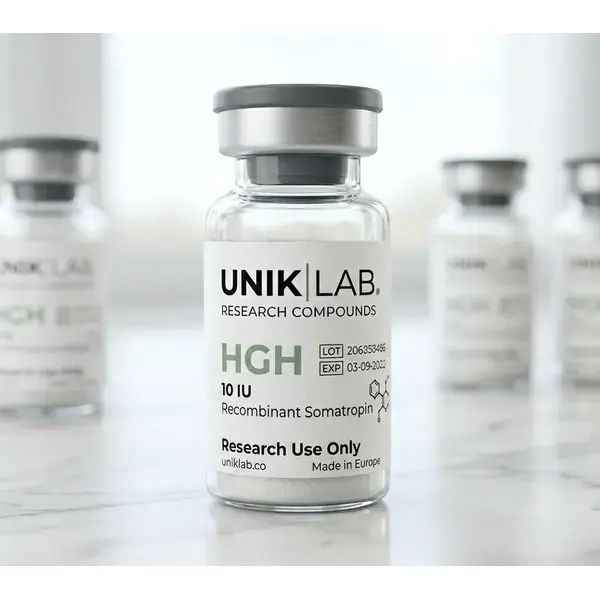
Recombinant Human Growth Hormone (191aa) — 10 IU per vial. HPLC verified ≥98% purity. For research use only.
Recombinant human growth hormone — somatotropin — is a 191-amino-acid single-chain protein synthesised by recombinant DNA technology to replicate the sequence of the endogenous hormone secreted by anterior pituitary somatotroph cells. As the most extensively characterised pituitary hormone, it has served as both a therapeutic reference standard and a fundamental research tool for studying GH receptor signalling, body composition regulation, and metabolic physiology.
The 191-residue sequence of recombinant human GH is identical to the predominant 22 kDa isoform of pituitary-derived somatotropin. Following subcutaneous administration, GH binds to the GH receptor (GHR), a class I cytokine receptor, triggering receptor dimerisation and activation of the JAK2/STAT5 signalling cascade. STAT5b is the primary transcriptional mediator of hepatic IGF-1 synthesis — the major circulating effector of GH's anabolic effects. The GH-IGF-1 axis represents one of the most thoroughly characterised endocrine signalling systems in mammalian biology, making recombinant GH an essential reference compound for research into growth regulation, metabolic adaptation, and endocrine pharmacology.
GH exerts both direct and IGF-1-mediated effects. Direct effects include activation of hormone-sensitive lipase in adipocytes (promoting lipolysis), modulation of hepatic glucose output, and stimulation of protein synthesis in muscle. IGF-1-mediated effects include promotion of longitudinal bone growth via growth plate chondrocyte stimulation, skeletal muscle hypertrophy, and organ growth. This dual direct/indirect pharmacology makes GH a particularly complex research tool for dissecting metabolic phenotypes.
The body composition effects of GH are among its most studied properties in research contexts. GH promotes a shift toward lean body mass through simultaneous lipolytic (fat-mobilising) and anabolic (muscle-preserving) effects. In GH-deficient rodent models — including hypophysectomised rats and dwarf mouse strains — recombinant GH administration restores lean/fat mass ratios, validates the endocrine axis, and enables dose-response characterisation. For in vitro metabolic research, GH stimulation of primary adipocytes, hepatocytes, and myotubes in culture provides tractable systems for interrogating GH receptor downstream signalling.
Recombinant human GH is used across a wide range of research contexts: as a positive control for GH receptor activation assays, as a comparator in studies of GHRH analogues (tesamorelin) and secretagogues (ipamorelin, CJC-1295 no DAC), and as a tool for reconstituting the GH-IGF-1 axis in hypophysectomised or GH-deficient animal models. It is also used in ageing biology research, where the somatopause — the progressive decline in GH secretory amplitude with advancing age — has been associated with adverse changes in body composition, bone density, and metabolic function.
This content is for informational purposes only and reflects the state of preclinical and clinical research. It does not constitute medical advice, endorsement of human use, or therapeutic claims of any kind.
Purity confirmed by High-Performance Liquid Chromatography at an accredited EU laboratory.
Every batch meets or exceeds 98% purity. CoA available for verification before dispatch.
Each vial is traceable to its synthesis batch, testing date, and analytical records.
European stock stored at optimal temperature from synthesis to dispatch.
Orders ship from EU stock within 48 hours with discrete, temperature-appropriate packaging.
Certificate of Analysis issued for every batch, available for download on request.
Peer-reviewed research supporting Recombinant Human Growth Hormone investigation.
Comprehensive review of GH's metabolic pharmacodynamics in human subjects, synthesising data from GH infusion studies, GH deficiency models, and comparative pharmacology. Authors systematically document GH's direct lipolytic effects in adipose tissue, its complex role in hepatic glucose metabolism, and its anabolic effects on protein synthesis in muscle — providing a definitive mechanistic framework for GH metabolic research.
View on PubMedSystematic evaluation of the GH-IGF-1 axis in the context of physical exercise, muscle adaptation, and body composition regulation. The review examines the acute and chronic GH secretory responses to exercise, the downstream IGF-1-mediated anabolic signalling in muscle and bone, and the research evidence for GH's role in exercise-induced tissue remodelling.
View on PubMedMechanistic review of GH receptor structure-function relationships, covering GHR dimerisation topology, JAK2/STAT5 signalling cascade architecture, and the structural basis for receptor specificity. The review provides the molecular framework for interpreting pharmacological GH receptor studies and understanding how structural features of the 191-residue GH molecule determine receptor activation geometry.
View on PubMedAll studies referenced are independent third-party research. UNIK LAB makes no claims regarding the therapeutic efficacy of any compound and does not represent or endorse the conclusions of cited studies. All referenced research was conducted under controlled laboratory or clinical conditions; results may not be predictive of effects in other experimental contexts.
Answers to the most frequently asked questions about Recombinant Human Growth Hormone.
Other Growth Hormone research compounds from our catalogue.
Recombinant human GH is a 191-amino-acid protein identical in sequence to the predominant 22 kDa pituitary somatotropin isoform. Produced by recombinant DNA technology, it provides a chemically defined research standard for GH receptor pharmacology with full biological activity at the GH receptor.
GH receptor dimerisation activates JAK2/STAT5b signalling, driving hepatic IGF-1 synthesis — the primary circulating mediator of GH's anabolic effects. The GH-IGF-1 endocrine axis is one of the most thoroughly characterised signalling cascades in mammalian biology, making recombinant GH an essential reference compound for growth factor research.
GH simultaneously activates hormone-sensitive lipase in adipocytes (promoting lipolysis) and stimulates protein synthesis in skeletal muscle, producing a lean-favouring shift in body composition. In hypophysectomised rodent models, recombinant GH administration restores lean/fat mass ratios and validates axis reconstitution.
GH exerts direct hepatic effects including modulation of glucose output, stimulation of IGF-1 synthesis, and regulation of fatty acid oxidation via JAK2/STAT5 and PI3K/Akt pathways. Primary hepatocyte cultures stimulated with recombinant GH are standard models for studying GH's role in hepatic metabolism and metabolic-associated liver disease.
GH binding triggers GHR homodimerisation, JAK2 transphosphorylation, and STAT5b nuclear translocation — the canonical GH signalling cascade. Cell lines stably expressing human GHR (e.g., 3T3-F442A, IM-9 lymphocytes) provide well-characterised in vitro systems for JAK2/STAT5 pathway assays and receptor pharmacology studies.
Recombinant human growth hormone (rhGH) is a 191-amino-acid single-chain protein synthesised using recombinant DNA technology — typically expression in E. coli or Chinese hamster ovary (CHO) cell systems. The resulting protein is identical in primary sequence to the predominant 22 kDa isoform of pituitary-derived somatotropin. UNIK LAB's rhGH is supplied in IU (International Units) format with specific activity expressed per mg protein, enabling precise experimental dosing.
GH binding causes GH receptor homodimerisation, triggering transphosphorylation of receptor-associated JAK2 kinases. Activated JAK2 phosphorylates STAT5a and STAT5b, which dimerize and translocate to the nucleus to activate target genes including IGF-1, SOCS proteins (negative feedback regulators), and metabolic enzymes. STAT5b is the primary mediator of hepatic IGF-1 synthesis. This pathway is the central focus of most GH receptor pharmacology assays.
Primary in vivo models include hypophysectomised rats (for complete GH axis ablation and reconstitution studies), dwarf rodent strains (Ames, Snell, lit/lit mice with GH deficiency or GHRHR mutations), GH receptor knockout mice (for IGF-1-independent GH effect studies), and diet-induced obese models (for GH's effects on adiposity and metabolic syndrome phenotypes). Each model provides different mechanistic windows into GH biology.
Lyophilised rhGH should be stored at 2–8°C, protected from light. As a 22 kDa protein, rhGH is more sensitive to mechanical denaturation than peptides — reconstitution should be performed by gentle rotation, not vortexing, in bacteriostatic water or sterile PBS. Reconstituted solution should be stored at 2–8°C and used within 14 days. Aggregation is a stability concern for larger proteins; avoid repeated freeze-thaw cycles.
Standard in vitro systems include 3T3-F442A pre-adipocytes (for differentiation and lipolysis assays), IM-9 human lymphocytes (which endogenously express GHR), HEK293 cells stably transfected with human GHR (for STAT5 reporter assays), primary human hepatocytes (for IGF-1 and metabolic gene expression studies), and C2C12 myotubes (for protein synthesis and metabolic endpoints). GH-stimulated STAT5 phosphorylation by Western blot is the most common signalling readout.
UNIK LAB's recombinant human GH achieves ≥98% purity by SDS-PAGE and HPLC, with molecular weight confirmation by LC-MS or MALDI-TOF (target 22,124 Da). Biological activity is verified by cell-based assay (STAT5 reporter or IGF-1 secretion assay). The specific activity in IU/mg is stated on the Certificate of Analysis for each batch.