HPLC Verified
Purity confirmed by High-Performance Liquid Chromatography at an accredited EU laboratory.
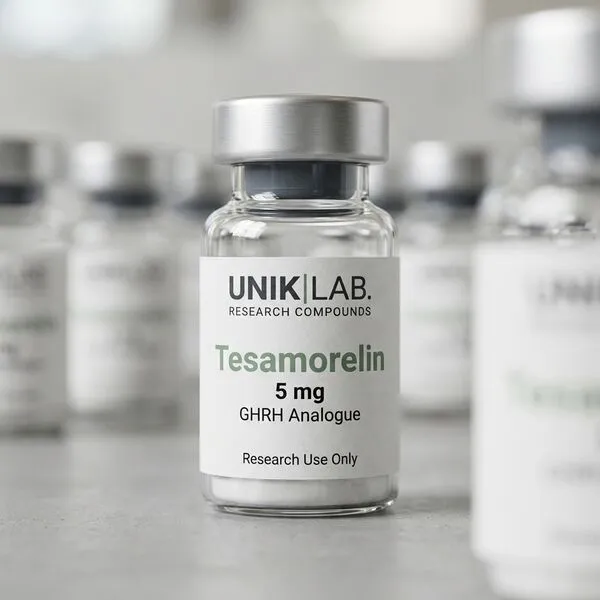
5mg GHRH analogue research compound
Tesamorelin is a synthetic analogue of endogenous growth hormone-releasing hormone (GHRH), in which the native forty-four-residue peptide is conjugated at its N-terminus to a trans-3-hexenoic acid moiety. This structural modification dramatically extends the peptide's plasma half-life relative to native GHRH while preserving full biological activity at the pituitary GHRH receptor — making it the only GHRH analogue that has undergone rigorous Phase 3 clinical evaluation.
Growth hormone-releasing hormone (GHRH) is secreted by hypothalamic neurons in pulses and acts on pituitary somatotroph cells via the GHRH receptor (GHRHR) — a G protein-coupled receptor coupled to adenylyl cyclase. The resulting increase in intracellular cAMP stimulates both GH synthesis and pulsatile GH secretion. GH then acts in liver to stimulate IGF-1 synthesis, while also exerting direct lipolytic effects in adipose tissue. The net metabolic consequences of pulsatile GH secretion include enhanced fat utilisation (particularly visceral adipose) and support for lean body composition — a physiology highly sensitive to the somatopause, the progressive decline in GH secretory amplitude that characterises normal ageing.
The trans-3-hexenoic acid modification at the N-terminus of tesamorelin prevents cleavage by dipeptidyl peptidase-4 (DPP-4), the enzyme responsible for the rapid inactivation of native GHRH (plasma half-life approximately 7 minutes). This pharmacokinetic advantage, combined with the preservation of native receptor binding geometry, results in a compound that can sustain pituitary GHRHR activation over experimentally relevant timeframes. The pharmacological consequence is amplification of endogenous pulsatile GH secretion rather than replacement — an important distinction from exogenous GH administration, as the hypothalamic-pituitary feedback axis remains intact.
Tesamorelin is the only GHRH analogue to have completed Phase 3 randomised controlled trials. Falutz and colleagues reported significant reductions in visceral adipose tissue (measured by CT) in HIV-associated lipodystrophy patients, leading to FDA approval in 2010 for this indication under the brand Egrifta. The clinical research data provide uniquely detailed pharmacodynamic information for a GHRH analogue, including dose-response characteristics, pituitary GH secretory dynamics, and tissue-specific metabolic consequences of GHRH receptor activation in humans.
This content is for informational purposes only and reflects the state of preclinical and clinical research. It does not constitute medical advice, endorsement of human use, or therapeutic claims of any kind.
Purity confirmed by High-Performance Liquid Chromatography at an accredited EU laboratory.
Every batch meets or exceeds 98% purity. CoA available for verification before dispatch.
Each vial is traceable to its synthesis batch, testing date, and analytical records.
European stock stored at optimal temperature from synthesis to dispatch.
Orders ship from EU stock within 48 hours with discrete, temperature-appropriate packaging.
Certificate of Analysis issued for every batch, available for download on request.
Peer-reviewed research supporting Tesamorelin investigation.
Phase 3 randomised controlled trial of tesamorelin in HIV-positive patients with lipodystrophy. Administration produced significant reductions in visceral adipose tissue (mean −15.2%), improvements in waist circumference, and favourable changes in lipid profiles compared to placebo, with GH and IGF-1 levels increasing within normal physiological ranges — demonstrating the capacity of GHRH receptor activation to modulate adipose distribution in human subjects.
View on PubMedExtension study examining the long-term safety and efficacy of tesamorelin over 52 weeks. Sustained reductions in visceral adipose tissue were maintained with continued administration; discontinuation resulted in progressive return toward baseline, confirming the administration-dependent nature of the effect and providing important pharmacodynamic insights for GHRH axis research.
View on PubMedSecondary analysis of Phase 3 tesamorelin trial data examining the metabolic consequences of visceral adipose tissue reduction. Decreases in visceral fat were associated with improvements in triglycerides, HDL cholesterol, and estimated cardiovascular risk, providing mechanistic context for the relationship between GHRH axis activity, visceral adiposity, and cardiometabolic risk markers.
View on PubMedAll studies referenced are independent third-party research. UNIK LAB makes no claims regarding the therapeutic efficacy of any compound and does not represent or endorse the conclusions of cited studies. All referenced research was conducted under controlled laboratory or clinical conditions; results may not be predictive of effects in other experimental contexts.
Answers to the most frequently asked questions about Tesamorelin.
Other Growth Hormone research compounds from our catalogue.
Tesamorelin is GHRH(1-44) conjugated with a trans-3-hexenoic acid moiety at the N-terminus. This modification prevents DPP-4-mediated cleavage that inactivates native GHRH within minutes, extending the pharmacokinetically active window while fully preserving GHRH receptor binding geometry and selectivity.
Tesamorelin activates the pituitary GHRH receptor via cAMP/adenylyl cyclase signalling, amplifying endogenous pulsatile GH secretion rather than replacing it. This preserves hypothalamic-pituitary feedback regulation, maintaining GH responses within physiological amplitude constraints — a key distinction from exogenous GH administration.
Phase 3 randomised controlled trials documented significant reductions in visceral adipose tissue (mean −15.2% by CT measurement) in HIV-associated lipodystrophy patients, leading to FDA approval in 2010. This clinical dataset provides uniquely detailed pharmacodynamic information for GHRH receptor activation in human subjects.
GHRH receptor activation via tesamorelin drives hepatic IGF-1 production through the GH-IGF-1 endocrine axis. Increases in circulating IGF-1 remain within normal physiological ranges, providing a research model for studying the downstream anabolic and metabolic consequences of controlled GH axis stimulation.
Phase 3 secondary endpoint analyses documented improvements in triglycerides, HDL cholesterol, and estimated cardiovascular risk markers associated with visceral adipose tissue reduction during tesamorelin administration. These data provide mechanistic context for the relationship between GHRH axis activity and cardiometabolic risk markers.
Tesamorelin is native GHRH(1-44) with a trans-3-hexenoic acid group conjugated to the alpha-amino group at the N-terminus. This modification prevents cleavage by dipeptidyl peptidase-4 (DPP-4), extending plasma half-life from approximately 7 minutes (native GHRH) to a pharmacologically relevant duration that enables sustained GHRH receptor activation in experimental settings.
GHRH (and GHRH analogues like tesamorelin) act upstream of GH at the level of pituitary somatotrophs, stimulating the physiological synthesis and pulsatile release of endogenous GH. This preserves hypothalamic-pituitary feedback regulation, so the GH response remains within physiological amplitude constraints. In contrast, exogenous GH bypasses this regulatory axis entirely. For research studying intact neuroendocrine regulation of the GH axis, tesamorelin is the more physiologically relevant tool.
In vitro systems include primary pituitary somatotroph cultures and GHRHR-expressing cell lines (e.g., GH3 cells) for receptor binding and cAMP assays. In vivo models include aged rodents (in which the somatopause has been characterised), diet-induced obese models (for visceral adipose biology), and hypophysectomised rats (for isolated GHRH axis reconstitution studies). Tesamorelin's clinical validation data also provide a uniquely rich source of human pharmacodynamic information for contextualising preclinical findings.
Tesamorelin received FDA approval in 2010 under the brand name Egrifta for the treatment of HIV-associated lipodystrophy — the only GHRH analogue to achieve regulatory approval for any indication. This regulatory status relates specifically to this indication in HIV patients; UNIK LAB supplies tesamorelin exclusively for in vitro and preclinical research purposes, not for therapeutic use.
Lyophilised tesamorelin should be stored at 2–8°C in sealed vials protected from light. As a 44-residue peptide with an N-terminal lipid modification, it requires careful handling during reconstitution. Sterile bacteriostatic water is the recommended reconstitution solvent; gentle mixing by rotation is preferred over vortexing to prevent aggregation. Reconstituted solution should be stored at 2–8°C and used within 14 days.
UNIK LAB's tesamorelin achieves ≥98% purity by HPLC with MS identity confirmation of the molecular weight (5,135.9 Da). The N-terminal trans-3-hexenoic acid modification is verified as part of the MS characterisation. Full CoA with HPLC chromatogram, MS data, batch number, and synthesis date is provided with each order.