HPLC Verified
Purity confirmed by High-Performance Liquid Chromatography at an accredited EU laboratory.
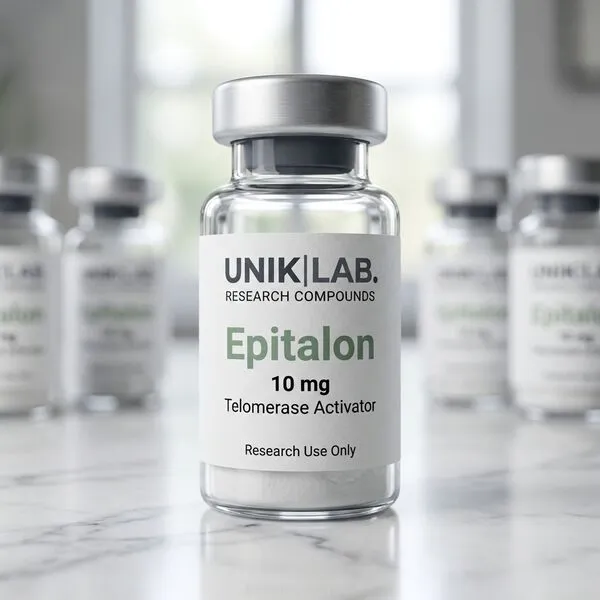
10mg telomerase research peptide
Epitalon — also rendered Epithalon — is a synthetic tetrapeptide (Ala-Glu-Asp-Gly) developed by the St. Petersburg Institute of Bioregulation and Gerontology during the 1980s and 90s. Its development was motivated by research into the pineal gland's role in biological ageing, and its most frequently cited property is the capacity to stimulate telomerase activity in somatic cell cultures.
Epitalon was designed as a synthetic analogue of Epitalamin, a polypeptide extract derived from bovine pineal glands. Epitalamin had been the subject of extensive Soviet-era research on ageing and immunomodulation, but its undefined mixture of peptide components made mechanistic investigation difficult. The four-residue synthetic derivative Epitalon was developed to provide a chemically defined, reproducible research tool with the core biological activity attributed to the pineal fraction.
The most extensively cited property of Epitalon in the research literature is its apparent capacity to stimulate telomerase activity in human somatic cells — a finding first published by Khavinson and colleagues in 2003. Telomerase, the ribonucleoprotein enzyme responsible for maintaining telomere length, is normally silenced in most differentiated somatic cells, with its re-activation being a characteristic feature of both cancer cells and certain regenerative stem cell populations. The observation that Epitalon could transiently activate telomerase in normal somatic cell cultures — including foetal kidney cells and human retinal cells — attracted substantial interest from researchers studying cellular senescence and the molecular biology of ageing.
Several studies from the St. Petersburg group, and independently replicated elements, have examined Epitalon's effects in animal longevity models. Work in fruit fly (Drosophila melanogaster) populations reported statistically significant extensions of mean and maximum lifespan in Epitalon-treated cohorts relative to controls. Rodent studies in multiple inbred strains documented reductions in spontaneous tumour incidence and improved preservation of immune function markers over time, though critical evaluation of these studies notes significant methodological variation across experiments.
A secondary area of Epitalon research concerns its apparent effects on pineal melatonin synthesis. Multiple studies report that Epitalon administration in rodents normalises age-related decreases in nocturnal melatonin production, suggesting a regulatory relationship between the peptide and pinealocyte function. This has made Epitalon of interest to circadian biology researchers and those studying the downstream consequences of age-associated melatonin decline on immune regulation and sleep architecture.
This content is for informational purposes only and reflects the state of preclinical research. It does not constitute medical advice, endorsement of human use, or therapeutic claims of any kind.
Purity confirmed by High-Performance Liquid Chromatography at an accredited EU laboratory.
Every batch meets or exceeds 98% purity. CoA available for verification before dispatch.
Each vial is traceable to its synthesis batch, testing date, and analytical records.
European stock stored at optimal temperature from synthesis to dispatch.
Orders ship from EU stock within 48 hours with discrete, temperature-appropriate packaging.
Certificate of Analysis issued for every batch, available for download on request.
Peer-reviewed research supporting Epitalon investigation.
Landmark cell culture study demonstrating Epitalon's capacity to stimulate telomerase activity in normal human somatic cell lines including foetal kidney cells. Authors report dose-dependent increases in telomerase activity and measurable telomere elongation after repeated administration cycles, positioning Epitalon as the first non-oncological small peptide demonstrated to activate telomerase in normal somatic cells.
View on PubMedA controlled longevity study in SHR mice examining the long-term effects of Epitalon administration on survival curves, spontaneous tumour incidence, and selected biomarkers of ageing. Epitalon-treated cohorts showed statistically significant improvements in median lifespan and reduced mammary adenocarcinoma incidence compared to vehicle-treated controls.
View on PubMedFollow-up investigation confirming telomerase activation findings and extending them to demonstrate that Epitalon-treated cell populations exceeded the Hayflick limit — the normally fixed number of cell divisions before senescence — in multiple somatic cell lineages, providing further mechanistic evidence for the compound's effects on cellular ageing processes.
View on PubMedInvestigation into Epitalon's effects on spontaneous mammary tumour development in a high-incidence mouse model. Treated animals showed delayed onset and reduced overall incidence of mammary adenocarcinomas compared to controls, with authors noting parallel effects on melatonin synthesis regulation as a potential mechanistic link.
View on PubMedAll studies referenced are independent third-party research. UNIK LAB makes no claims regarding the therapeutic efficacy of any compound and does not represent or endorse the conclusions of cited studies. All referenced research was conducted under controlled laboratory or clinical conditions; results may not be predictive of effects in other experimental contexts.
Answers to the most frequently asked questions about Epitalon.
Other Anti-Aging research compounds from our catalogue.
Epitalon is the first non-oncological peptide reported to stimulate telomerase activity in normal human somatic cells, including foetal kidney and retinal cell lines. Dose-dependent increases in telomerase activity and measurable telomere elongation have been documented in cell culture studies by Khavinson and colleagues.
Epitalon (Ala-Glu-Asp-Gly) is a chemically defined four-residue analogue of Epitalamin, the bovine pineal gland polypeptide extract used in Soviet ageing research. Its defined sequence provides reproducibility and mechanistic tractability unavailable with the parent polypeptide mixture.
Animal longevity studies report statistically significant lifespan extension in Drosophila melanogaster populations and reduced spontaneous tumour incidence in SHR and C3H/He mouse strains. These observations have positioned Epitalon within the landscape of peptide bioregulators studied in ageing model systems.
Multiple rodent studies report that Epitalon normalises age-associated declines in nocturnal melatonin production, suggesting a regulatory interaction with pinealocyte function. This relationship with pineal biology has made Epitalon a tool for investigating circadian rhythm regulation and sleep architecture research.
Studies in aged rodent models report partial restoration of T-lymphocyte proliferative responses, normalisation of CD4:CD8 ratio alterations, and effects on NK cell activity consistent with attenuation of age-associated immune decline. These observations place Epitalon within the broader field of peptide bioregulators and their relationship to immune ageing.
Epitalon is a synthetic tetrapeptide (Ala-Glu-Asp-Gly) developed as a research tool by the St. Petersburg Institute of Bioregulation and Gerontology during the 1980s–90s. It was designed as a chemically defined analogue of Epitalamin, a bovine pineal gland polypeptide extract used in earlier Soviet ageing research. Epitalon exists purely as a research compound with no regulatory approval for therapeutic use.
Cell culture studies, primarily from Khavinson and colleagues, have reported that Epitalon stimulates telomerase activity in normal human somatic cells. Telomerase is the enzyme responsible for maintaining the protective telomere caps on chromosomal ends; it is typically inactive in differentiated somatic cells. Whether this in vitro telomerase activation translates to meaningful biological effects in vivo remains an active area of investigation that requires further independent validation.
Epitalon's structural similarity to Epitalamin — the native pineal peptide extract — has prompted research into its effects on pineal function. Studies in aged rodents report that Epitalon administration partially normalises age-associated declines in nocturnal melatonin secretion, suggesting a regulatory interaction with pinealocyte function. This relationship between the synthetic peptide and endogenous pineal biology is an ongoing area of mechanistic research.
The most commonly reported models include: Drosophila melanogaster (fruit fly lifespan studies), multiple inbred mouse strains (SHR, C3H/He, CBA) for longevity and tumour incidence research, and rats for neuroendocrine and circadian biology investigations. Cell culture work has used human foetal kidney cells, retinal cells, and fibroblast lines for mechanistic telomerase studies.
UNIK LAB's Epitalon achieves ≥98% purity verified by HPLC, with molecular identity confirmed by LC-MS. Given its small size (MW 390.35 Da), mass accuracy is particularly reliable for this compound. Each batch carries a unique CoA with purity percentage, MS data, and full traceability from synthesis to dispatch.
Lyophilised Epitalon is stable at 2–8°C for up to 24 months when stored in a sealed, desiccated container protected from light. The tetrapeptide is relatively stable compared to larger peptides due to its small size and absence of easily oxidised residues, but standard cryogenic storage protocols should still be followed. Reconstituted solutions should be used within 28 days and stored at 2–8°C.
Yes. Several studies from the St. Petersburg group have examined Epitalon's effects on age-associated immune decline. Reported findings include partial restoration of T-lymphocyte proliferative responses in aged rodents, normalisation of CD4:CD8 ratio alterations associated with immunosenescence, and effects on NK cell activity. These observations have positioned Epitalon within the broader field of peptide bioregulators and their relationship to immune ageing.
Epitalon belongs to a class of peptides called cytamins or peptide bioregulators, developed by the St. Petersburg Institute over several decades. Related compounds include Thymalin (thymus-derived), Cortexin (cerebral cortex-derived), and Vilon. These compounds share the concept of short tissue-specific peptide sequences derived from or inspired by glandular extracts, though they differ in tissue target and reported biological activity.