HPLC Verified
Purity confirmed by High-Performance Liquid Chromatography at an accredited EU laboratory.
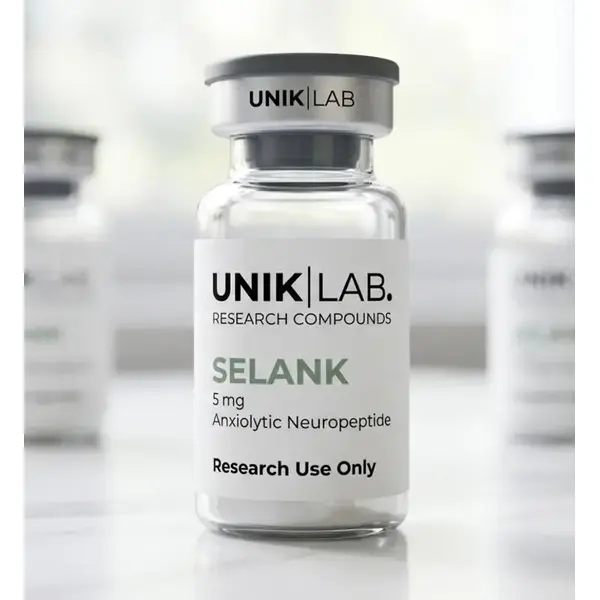
5mg anxiolytic cognitive research peptide
Selank — systematic designation TP-7 — is a synthetic heptapeptide analogue of tuftsin, an endogenous tetrapeptide (Thr-Lys-Pro-Arg) derived from the Fc region of immunoglobulin G. Developed at the Institute of Molecular Genetics of the Russian Academy of Sciences, Selank extends the tuftsin sequence with a C-terminal Pro-Gly-Pro tripeptide that dramatically increases resistance to proteolytic degradation and enhances central nervous system penetration.
Tuftsin (Thr-Lys-Pro-Arg) is an endogenous immunomodulatory tetrapeptide liberated from the Fc region of IgG by two enzymes: leukokinase and tuftsin endocarboxypeptidase. It exhibits immunostimulatory activity through macrophage and neutrophil activation. Selank (Thr-Lys-Pro-Arg-Pro-Gly-Pro) was designed to preserve tuftsin's core pharmacophore while adding a stability-conferring C-terminal extension. The Pro-Gly-Pro tripeptide provides resistance to aminopeptidases and endopeptidases that rapidly inactivate native tuftsin in vivo, extending the compound's pharmacokinetically active window and enabling CNS studies not feasible with the parent tetrapeptide.
The most extensively documented pharmacological property of Selank in preclinical literature is its anxiolytic activity mediated through the GABAergic system. Studies in rodent models have documented benzodiazepine-comparable anxiolytic effects in elevated plus-maze, open field, and fear conditioning paradigms, without the tolerance, dependence, or sedation observed with classical GABAergic anxiolytic drugs. The proposed mechanism involves potentiation of GABA-A receptor-mediated chloride conductance through an allosteric mechanism distinct from the benzodiazepine binding site. This selectivity profile has made Selank of interest as a pharmacological tool for dissecting GABAergic anxiety circuitry.
A second pharmacological signature of Selank concerns its effects on neurotrophin expression. Studies in rodent brain tissue have documented upregulation of brain-derived neurotrophic factor (BDNF) and nerve growth factor (NGF) following Selank administration, particularly in hippocampal and frontal cortex regions. BDNF is a critical mediator of synaptic plasticity, long-term potentiation, and neuronal survival. The upregulation of this pathway — alongside documented improvements in learning and memory task performance in rodent models — has positioned Selank as a research tool in the field of neuropeptide cognitive pharmacology. Additionally, Selank modulates expression of interleukin-6, interferon-γ, and other cytokines, reflecting its tuftsin-derived immunomodulatory heritage.
This content is for informational purposes only and reflects the state of preclinical research. It does not constitute medical advice, endorsement of human use, or therapeutic claims of any kind.
Purity confirmed by High-Performance Liquid Chromatography at an accredited EU laboratory.
Every batch meets or exceeds 98% purity. CoA available for verification before dispatch.
Each vial is traceable to its synthesis batch, testing date, and analytical records.
European stock stored at optimal temperature from synthesis to dispatch.
Orders ship from EU stock within 48 hours with discrete, temperature-appropriate packaging.
Certificate of Analysis issued for every batch, available for download on request.
Peer-reviewed research supporting Selank investigation.
Pharmacological characterisation of Selank's behavioural and neurochemical profile in rodent models. The study documents anxiolytic activity in elevated plus-maze and open field paradigms, alongside effects on monoamine neurotransmitter systems. Neurochemical data show modulation of serotonergic and dopaminergic markers in limbic brain regions consistent with the compound's anxiolytic pharmacology.
View on PubMedClinical investigation examining Selank's immunomodulatory profile in patients with anxiety-related disorders. The study documents modulation of cytokine expression including IL-6, interferon-γ, and TNF-α, consistent with the tuftsin-derived immunopharmacological properties of the compound and providing human-relevant data on Selank's dual CNS-immune activity.
View on PubMedFoundational pharmacological study of tuftsin analogues establishing the structure-activity relationships relevant to Selank's design. The study identifies the key pharmacophore elements required for immunomodulatory and anxiolytic activity in the tuftsin peptide series, providing the mechanistic basis for the C-terminal Pro-Gly-Pro extension strategy used in Selank development.
View on PubMedAll studies referenced are independent third-party research. UNIK LAB makes no claims regarding the therapeutic efficacy of any compound and does not represent or endorse the conclusions of cited studies. All referenced research was conducted under controlled laboratory or clinical conditions; results may not be predictive of effects in other experimental contexts.
Answers to the most frequently asked questions about Selank.
Other Cognitive research compounds from our catalogue.
Selank is a synthetic heptapeptide (Thr-Lys-Pro-Arg-Pro-Gly-Pro) extending the endogenous immunopeptide tuftsin (TKPR) with a C-terminal Pro-Gly-Pro sequence. This extension provides proteolytic resistance and enhanced CNS penetration compared to native tuftsin, enabling central pharmacological research not feasible with the parent compound.
Selank produces benzodiazepine-comparable anxiolytic effects in rodent models (elevated plus-maze, open field, fear conditioning) via GABAergic system potentiation. The proposed mechanism involves GABA-A receptor allosteric modulation through a site distinct from the classical benzodiazepine binding site, without associated tolerance or dependence in preclinical studies.
Selank administration upregulates brain-derived neurotrophic factor (BDNF) and nerve growth factor (NGF) expression in hippocampal and frontal cortex regions of rodent brain. BDNF is a central mediator of synaptic plasticity and long-term potentiation, positioning Selank as a research tool for neuroplasticity and neuroprotection studies.
Preclinical studies document improved performance in learning and memory paradigms (Morris water maze, passive avoidance, radial arm maze) following Selank administration in rodent models. These neurotrophin-mediated cognitive effects have generated interest in Selank as a research tool for studying neuropeptide regulation of hippocampal-dependent memory processes.
Reflecting its tuftsin-derived architecture, Selank modulates innate immune signalling including IL-6, TNF-α, and interferon-γ expression. These immunomodulatory properties have been studied in models of anxiety-immune crosstalk, consistent with the bidirectional relationship between CNS peptide signalling and peripheral immune function.
Selank (TKPRPGP) is a synthetic heptapeptide derived from tuftsin (TKPR), an endogenous tetrapeptide liberated from the Fc region of IgG. While tuftsin has known immunostimulatory properties, it is rapidly degraded in vivo. Selank extends the tuftsin sequence with a C-terminal Pro-Gly-Pro tripeptide that dramatically increases proteolytic stability and CNS penetration, enabling central pharmacological activity that the parent compound cannot sustain.
Preclinical studies propose GABA-A receptor potentiation as the primary anxiolytic mechanism, with electrophysiological data suggesting allosteric modulation at a site distinct from the classical benzodiazepine binding locus. Unlike benzodiazepines, Selank in rodent studies does not produce significant sedation, muscle relaxation, or tolerance/dependence phenotypes. This differential pharmacological profile makes it a useful comparative tool for studying GABAergic anxiety circuitry.
Yes. Multiple rodent studies report improvements in spatial memory (Morris water maze), contextual fear memory (passive avoidance), and working memory (radial arm maze) following Selank administration. The proposed cognitive mechanism involves BDNF upregulation in hippocampus, a region critical for declarative memory consolidation. Neurochemical studies also document effects on catecholamine turnover in prefrontal cortical regions relevant to attention and working memory.
Lyophilised Selank should be stored at 2–8°C in sealed vials protected from light and moisture. As a relatively small heptapeptide (863 Da), it has good aqueous solubility and stability. Reconstitution in sterile bacteriostatic water or sterile PBS at 1–5 mg/mL is standard for research use. Reconstituted solution should be stored at 2–8°C and used within 21 days.
UNIK LAB's Selank achieves ≥98% purity by HPLC with mass spectrometry identity confirmation of the molecular weight (863.0 Da) and sequence. The Pro-Gly-Pro C-terminal extension is verified as part of the MS characterisation. A Certificate of Analysis with full analytical data and batch traceability is provided with each order.
Standard models include primary rat hippocampal neuron cultures for BDNF/NGF expression assays (qRT-PCR, ELISA), cortical and cerebellar neuron cultures for neuroprotection endpoints (LDH release, MTT viability), GABA-A receptor-expressing Xenopus oocyte systems for electrophysiological characterisation, and peripheral blood mononuclear cells (PBMCs) for cytokine profiling assays reflecting the compound's immunomodulatory properties.