HPLC Verified
Purity confirmed by High-Performance Liquid Chromatography at an accredited EU laboratory.
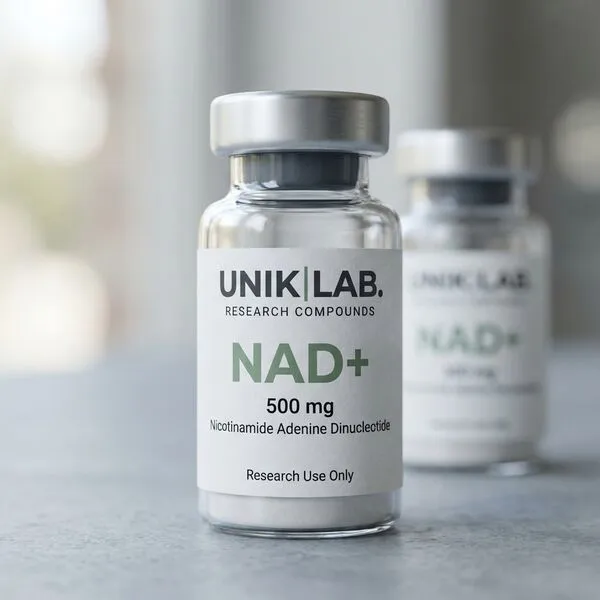
500mg coenzyme research compound
Nicotinamide adenine dinucleotide (NAD⁺) is a coenzyme found in every living cell, serving as the central redox carrier in cellular energy metabolism and as a substrate for a growing family of enzymes — sirtuins, PARPs, and CD38 — whose activity is inseparably linked to the molecule's availability. Its cellular concentration declines systematically with age, a finding that has made NAD⁺ biology one of the most actively studied fields in geroscience.
NAD⁺ functions as a hydride acceptor in glycolysis, the citric acid cycle, and beta-oxidation of fatty acids, cycling between its oxidised (NAD⁺) and reduced (NADH) forms to shuttle electrons to the mitochondrial electron transport chain. This continuous cycling is essential for ATP synthesis; disruptions to the NAD⁺/NADH ratio profoundly alter cellular metabolism. The total NAD⁺ pool — encompassing both NAD⁺ and NADH — represents one of the most highly conserved and abundant cellular metabolites across all domains of life.
Beyond its redox role, NAD⁺ is consumed — rather than recycled — as a co-substrate by three enzyme classes with profound implications for ageing biology. Sirtuins (SIRT1-7) are NAD⁺-dependent deacylases and ADP-ribosyltransferases that regulate chromatin structure, DNA repair, metabolic adaptation, and mitochondrial biogenesis. Poly(ADP-ribose) polymerases (PARPs) consume NAD⁺ during DNA damage responses. CD38 — a multifunctional ectoenzyme — is a major NAD⁺-consuming enzyme whose expression increases dramatically with age and inflammatory signalling, contributing significantly to the age-associated decline in cellular NAD⁺.
The observation that NAD⁺ levels in mammalian tissues decline 40–60% between young adulthood and old age — reported across rodent studies and corroborated by human blood metabolomics data — has been a driving force in NAD⁺ research. Rajman and colleagues synthesised this evidence in a landmark 2018 review in Cell Metabolism, identifying NAD⁺ decline as a potential mechanistic contributor to multiple hallmarks of ageing including impaired mitochondrial function, increased genomic instability, and reduced sirtuin activity.
A substantial body of preclinical work has examined whether restoring NAD⁺ levels — through direct supplementation or through precursors such as NMN and NR — can reverse functional markers of biological ageing in rodent models. Studies have reported improvements in skeletal muscle function, cognitive performance, cardiovascular parameters, and metabolic flexibility in aged mice following NAD⁺ or NAD⁺ precursor repletion. Mechanistic analyses have consistently implicated sirtuin reactivation and improved mitochondrial quality control as key downstream mediators of these effects.
This content is for informational purposes only and reflects the state of preclinical research. It does not constitute medical advice, endorsement of human use, or therapeutic claims of any kind.
Purity confirmed by High-Performance Liquid Chromatography at an accredited EU laboratory.
Every batch meets or exceeds 98% purity. CoA available for verification before dispatch.
Each vial is traceable to its synthesis batch, testing date, and analytical records.
European stock stored at optimal temperature from synthesis to dispatch.
Orders ship from EU stock within 48 hours with discrete, temperature-appropriate packaging.
Certificate of Analysis issued for every batch, available for download on request.
Peer-reviewed research supporting NAD⁺ investigation.
A comprehensive review synthesising preclinical evidence for NAD⁺ restoration strategies across ageing-relevant phenotypes. Authors systematically evaluate rodent studies demonstrating improvements in muscle function, neurocognition, cardiovascular parameters, and metabolic regulation following NAD⁺ or precursor repletion, and discuss mechanistic pathways including sirtuin activation and PARP modulation.
View on PubMedLandmark study demonstrating that NAD⁺ precursor supplementation in mice enhances oxidative metabolism, increases mitochondrial biogenesis via SIRT1/SIRT3 activation, and confers protection against high-fat diet-induced metabolic dysfunction. The study provided foundational mechanistic evidence linking NAD⁺ levels to sirtuin-mediated metabolic regulation.
View on PubMedSystematic evaluation of NAD⁺ biosynthetic intermediates and their biological roles, with particular focus on NMN and NR as research tools for NAD⁺ repletion. Authors compare pharmacokinetic properties, tissue distribution patterns, and reported biological effects across multiple model systems, providing a framework for experimental design in NAD⁺ biology research.
View on PubMedMechanistic investigation revealing that age-associated NAD⁺ decline disrupts communication between the nuclear and mitochondrial genomes, producing a pseudohypoxic state characterised by inappropriate HIF-1α stabilisation and impaired mitochondrial function. NAD⁺ repletion restored nuclear-mitochondrial communication and mitochondrial integrity in aged mouse muscle.
View on PubMedAll studies referenced are independent third-party research. UNIK LAB makes no claims regarding the therapeutic efficacy of any compound and does not represent or endorse the conclusions of cited studies. All referenced research was conducted under controlled laboratory or clinical conditions; results may not be predictive of effects in other experimental contexts.
Answers to the most frequently asked questions about NAD⁺.
Other Anti-Aging research compounds from our catalogue.
NAD⁺ cycles between oxidised (NAD⁺) and reduced (NADH) forms as a hydride acceptor in glycolysis, the TCA cycle, and beta-oxidation, shuttling electrons to the mitochondrial electron transport chain. Disruptions to the NAD⁺/NADH ratio profoundly alter cellular energy metabolism across all domains of life.
Sirtuins (SIRT1-7) are NAD⁺-dependent deacylases that regulate chromatin structure, DNA repair, metabolic gene expression, and mitochondrial biogenesis. Unlike redox cycling, sirtuin activity consumes NAD⁺ irreversibly, directly linking cellular NAD⁺ availability to epigenetic regulation and ageing biology.
Poly(ADP-ribose) polymerases (PARPs) consume NAD⁺ as a substrate during DNA damage repair responses. Age-associated increases in DNA damage drive chronic PARP activation, contributing to the progressive depletion of cellular NAD⁺ pools observed in senescent tissues.
NAD⁺ levels in mammalian tissues decline 40–60% between young adulthood and senescence in rodent models, corroborated by human blood metabolomics data. This decline is a major geroscience research target, positioning NAD⁺ biology at the intersection of ageing, metabolism, and genomic stability research.
Age-associated NAD⁺ decline disrupts nuclear-mitochondrial communication, producing a pseudohypoxic state with inappropriate HIF-1α stabilisation and impaired mitochondrial function. NAD⁺ repletion in preclinical models restores this communication and improves mitochondrial integrity in aged muscle tissue.
NAD⁺ (nicotinamide adenine dinucleotide) is a coenzyme present in every living cell. It serves two fundamental roles: as a redox carrier cycling between NAD⁺ and NADH during energy metabolism (glycolysis, the Krebs cycle, and beta-oxidation), and as a co-substrate consumed by three major enzyme families — sirtuins, PARPs, and CD38 — that regulate gene expression, DNA repair, and metabolic adaptation. It is among the most abundant and functionally critical small molecules in cellular biochemistry.
The age-associated decline in cellular NAD⁺ (estimated at 40–60% between young adulthood and senescence in rodent models) results from multiple converging mechanisms: increased PARP activity in response to age-associated DNA damage, upregulation of CD38 (a major NAD⁺-consuming ectoenzyme) with chronic low-grade inflammation, and potential decline in biosynthetic enzyme activity. The resulting decrease in sirtuin substrate availability has been proposed as a contributor to multiple hallmarks of cellular ageing.
Sirtuins (SIRT1-7) are NAD⁺-dependent enzymes that deacetylate histones and non-histone proteins to regulate chromatin accessibility, DNA repair, metabolic gene expression, and mitochondrial quality control. Their activity is directly proportional to NAD⁺ availability, meaning that the age-associated decline in NAD⁺ functionally impairs sirtuin activity. This mechanistic link has made NAD⁺ biology central to research on the molecular hallmarks of ageing, particularly in the context of Sinclair's work on epigenetic ageing and mitochondrial decline.
NMN (nicotinamide mononucleotide) and NR (nicotinamide riboside) are biosynthetic precursors to NAD⁺ — they are converted to NAD⁺ intracellularly via the Preiss-Handler or salvage pathways. NAD⁺ itself is the complete coenzyme. Research tools may include direct NAD⁺, its precursors, or specific biosynthetic enzyme substrates depending on the experimental question. Precursors are often studied as pharmacological tools due to their different membrane permeability profiles.
Common in vitro models include primary cultures of skeletal muscle myotubes (for metabolic and mitochondrial studies), primary neurons (for NAD⁺'s role in neurodegeneration research), hepatocytes (for metabolic flux analysis), and various senescent cell lines where NAD⁺ depletion can be induced pharmacologically. Reporter cell lines expressing NAD⁺-sensitive biosensors (e.g., Peredox) have also been developed for real-time NAD⁺/NADH ratio measurement.
UNIK LAB's NAD⁺ is supplied at ≥98% purity verified by HPLC, with identity confirmed by mass spectrometry (MW 663.43 Da). We supply the oxidised form (NAD⁺), not NADH. Each batch is accompanied by a Certificate of Analysis including HPLC chromatogram, MS data, and batch traceability. The compound is supplied as a lyophilised powder for research use.
Lyophilised NAD⁺ is hygroscopic and should be handled in a dry environment. Reconstitution is typically performed in cold sterile water or PBS at physiologically relevant pH (7.0–7.4), as NAD⁺ degrades at alkaline pH. Working solutions should be prepared fresh or stored at 2–8°C in small aliquots; repeated freeze-thaw cycles accelerate degradation. For cell culture experiments, NAD⁺ is typically applied at millimolar concentrations given its limited membrane permeability.