HPLC Verified
Purity confirmed by High-Performance Liquid Chromatography at an accredited EU laboratory.
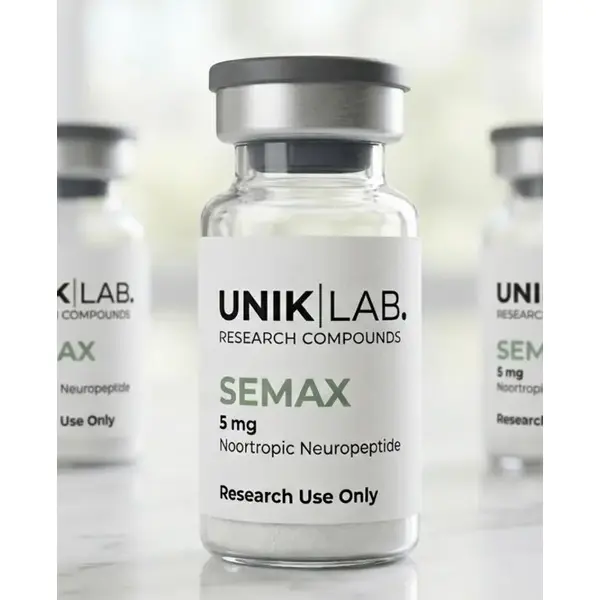
5mg nootropic ACTH-analogue research peptide
Semax is a synthetic heptapeptide analogue of the ACTH(4-10) fragment — the core behaviorally active sequence of adrenocorticotropic hormone — engineered for enhanced stability and CNS activity. Unlike the parent ACTH molecule, Semax does not bind melanocortin receptors or stimulate adrenocortical steroidogenesis; its biological activities are exclusively neurotrophin-mediated and neuroprotective in character.
The ACTH(4-10) fragment (Met-Glu-His-Phe-Pro-Gly-Pro) was identified during early structure-activity studies of ACTH as the minimal sequence responsible for the hormone's behavioural and cognitive effects. These effects are independent of the melanocortin receptor binding and adrenal steroidogenic activity mediated by the full ACTH molecule. Semax (Met-Glu-His-Phe-Pro-Gly-Pro) replicates this sequence with enhanced conformational stability conferred by its cyclic C-terminal Pro-Gly-Pro motif, providing improved resistance to aminopeptidase degradation and a longer pharmacokinetically effective window than the native fragment. The compound was developed at the Institute of Molecular Genetics, Moscow, as part of a programme investigating CNS-active peptides derived from pituitary hormone sequences.
The most extensively studied pharmacological property of Semax concerns its capacity to upregulate neurotrophin expression in brain tissue. Multiple rodent studies document increases in BDNF (brain-derived neurotrophic factor), NGF (nerve growth factor), and their respective receptor systems (TrkB, TrkA) following Semax administration, with particularly robust effects in hippocampus, striatum, and frontal cortex. These neurotrophin responses are proposed as the mechanistic basis for Semax's documented neuroprotective effects in ischaemia models, where pre- or post-administration of Semax reduces infarct volume, attenuates glutamate excitotoxicity, and improves functional recovery metrics relative to untreated controls. The compound's activity in oxidative stress models further supports a neurotrophin-mediated neuroprotective mechanism.
Semax demonstrates consistent effects on learning and memory task performance across multiple rodent paradigms including Morris water maze, passive avoidance, and operant conditioning protocols. Neurochemical studies document modulation of dopamine and serotonin systems — including altered catecholamine turnover in prefrontal cortical regions and hippocampal monoamine profiles. These effects are consistent with the compound's proposed activity as a neuropeptide that amplifies neurotrophin-dependent synaptic plasticity, with downstream consequences for monoaminergic neurotransmission. Semax has also been investigated in models of attention-deficit research and stress-induced cognitive impairment, where its neurotrophin-upregulating properties may counteract stress-related BDNF suppression.
This content is for informational purposes only and reflects the state of preclinical research. It does not constitute medical advice, endorsement of human use, or therapeutic claims of any kind.
Purity confirmed by High-Performance Liquid Chromatography at an accredited EU laboratory.
Every batch meets or exceeds 98% purity. CoA available for verification before dispatch.
Each vial is traceable to its synthesis batch, testing date, and analytical records.
European stock stored at optimal temperature from synthesis to dispatch.
Orders ship from EU stock within 48 hours with discrete, temperature-appropriate packaging.
Certificate of Analysis issued for every batch, available for download on request.
Peer-reviewed research supporting Semax investigation.
Mechanistic study establishing Semax's capacity to upregulate TrkA and TrkB neurotrophin receptor expression and activity in rat basal forebrain. Authors document increased NGF and BDNF receptor levels alongside enhanced neurotrophin-mediated signalling, providing a molecular framework for Semax's cognitive and neuroprotective effects observed in behavioural models.
View on PubMedInvestigation of Semax's effects on opiate dependence development in rodent models, demonstrating modulation of dopaminergic reward circuitry. The study documents attenuation of morphine-induced conditioned place preference and withdrawal symptoms, consistent with Semax's reported effects on striatal dopamine turnover and mesolimbic pathway neuroplasticity.
View on PubMedStudy examining Semax's effects on stress-induced suppression of BDNF and TrkB expression in rodent brain. Semax administration partially reversed stress-induced downregulation of hippocampal BDNF and its receptor, providing mechanistic evidence for Semax as a neuropeptide that counteracts stress-related neurotrophin depletion — relevant to cognitive impairment in chronic stress models.
View on PubMedAll studies referenced are independent third-party research. UNIK LAB makes no claims regarding the therapeutic efficacy of any compound and does not represent or endorse the conclusions of cited studies. All referenced research was conducted under controlled laboratory or clinical conditions; results may not be predictive of effects in other experimental contexts.
Answers to the most frequently asked questions about Semax.
Other Cognitive research compounds from our catalogue.
Semax (Met-Glu-His-Phe-Pro-Gly-Pro) replicates the behaviourally active core sequence of ACTH without binding melanocortin receptors or stimulating adrenocortical steroidogenesis. The C-terminal Pro-Gly-Pro motif provides enhanced aminopeptidase resistance compared to native ACTH(4-10), extending the pharmacokinetically active window for CNS studies.
Multiple rodent studies document Semax-induced upregulation of BDNF, NGF, and their TrkB/TrkA receptor systems in hippocampus, striatum, and frontal cortex. BDNF is a central mediator of synaptic plasticity and long-term potentiation, making Semax a valuable research tool for neuroplasticity and neurotrophin pathway investigations.
In rodent cerebral ischaemia models, Semax pre- or post-administration reduces infarct volume, attenuates glutamate excitotoxicity, and improves functional recovery metrics. Antioxidant gene expression upregulation and neurotrophin-mediated neuronal survival signalling are proposed as the primary neuroprotective mechanisms.
Semax consistently improves performance in spatial memory (Morris water maze), contextual memory (passive avoidance), and operant conditioning paradigms across rodent models. These cognitive-enhancing effects have been attributed to BDNF-mediated enhancement of hippocampal long-term potentiation and synaptic density.
Neurochemical studies document Semax effects on dopamine and serotonin turnover in prefrontal cortex and hippocampus, including altered catecholamine metabolite ratios. These monoaminergic effects are consistent with neurotrophin-driven modulation of synaptic transmission and position Semax as a research tool for studying neuropeptide-monoamine interactions in cognitive circuitry.
Semax is a synthetic heptapeptide analogue of the ACTH(4-10) fragment of adrenocorticotropic hormone. While full ACTH binds melanocortin receptors (MC1R-MC5R) and stimulates adrenal cortisol and steroid synthesis, Semax does not bind these receptors. Its pharmacological activity is exclusively CNS-directed, acting through neurotrophin upregulation rather than steroidogenic signalling. This makes Semax a cleaner research tool than full ACTH for studying neuropeptide cognitive effects without adrenal confounds.
Multiple preclinical studies have shown that Semax administration upregulates BDNF (brain-derived neurotrophic factor) expression in hippocampus, frontal cortex, and striatum. BDNF is a critical mediator of synaptic plasticity, neuronal survival, and long-term potentiation. The BDNF upregulation is proposed as the primary mechanism for Semax's neuroprotective and cognitive-enhancing effects, making it a pharmacological tool for studying the regulation of hippocampal BDNF signalling by neuropeptide systems.
The primary neuroprotection models include transient middle cerebral artery occlusion (MCAO) in rats for cerebral ischaemia research, glutamate excitotoxicity models in primary neuron cultures, oxidative stress models using H2O2 or rotenone in neuronal cell lines, and scopolamine-induced cognitive impairment models for acetylcholine system research. Consistent findings include reduced neuronal death markers, improved mitochondrial function metrics, and preserved neurotrophin signalling in Semax-treated preparations.
Lyophilised Semax should be stored at 2–8°C in sealed vials protected from light and moisture. As a heptapeptide with a methionine residue, oxidation of the methionine side chain is a potential degradation pathway; storage under inert atmosphere is recommended for long-term stability. Reconstitution in sterile bacteriostatic water or sterile saline at 1–5 mg/mL is standard. Reconstituted solution should be used within 21 days when stored at 2–8°C.
UNIK LAB's Semax achieves ≥98% purity by HPLC with mass spectrometry identity confirmation of the molecular weight (887.0 Da). The methionine oxidation state is verified as part of the MS characterisation to confirm the non-oxidised form. A Certificate of Analysis with full analytical data and batch traceability is provided with each order.
Standard models include primary rat hippocampal and cortical neuron cultures for BDNF/NGF expression assays (ELISA, qRT-PCR), neuronal cell lines (SH-SY5Y, PC12) for neuroprotection and TrkA/TrkB signalling studies, primary cerebellar granule cells for glutamate excitotoxicity assays, and rat prefrontal cortex tissue for neurochemical monoamine analysis. Calcium imaging in hippocampal neurons is used for LTP-related mechanistic studies.