⏱️ Reading time: ~18 min | Updated: May 2026 | UNIK LAB Research Team
Semaglutide vs Retatrutide: Mechanism, Efficacy, and Comparative Research
−14.9% versus −24.2%. Two numbers separated by less than a decade of incretin pharmacology — and a gap that redefines what metabolic research considers achievable.
Retatrutide 5mg — Research Grade
HPLC ≥98% purity · CoA included · EU sourced
Why This Comparison Matters
−14.9% versus −24.2%. Those two numbers — separated by nearly a decade of incretin pharmacology — are why researchers worldwide are paying close attention to the difference between semaglutide and retatrutide.
Semaglutide (Ozempic, Wegovy) became the compound that redefined metabolic research. The STEP 1 trial published in NEJM in 2021 showed what was then considered a near-ceiling for pharmacological weight reduction in a non-surgical intervention: 14.9% mean body weight loss at 68 weeks (Wilding JPH et al., NEJM 2021, PMID 33567185). The pharma world called it a breakthrough. The clinical community agreed.
Then Eli Lilly filed Phase 2 data on LY3437943 — a molecule they named retatrutide. The NEJM 2023 publication showed 24.2% mean body weight reduction at just 48 weeks (Jastreboff AM et al., NEJM 2023, PMID 37366315). A compound that had never been approved for anything produced results in a controlled trial that surpassed the benchmark everyone had accepted as the new normal.
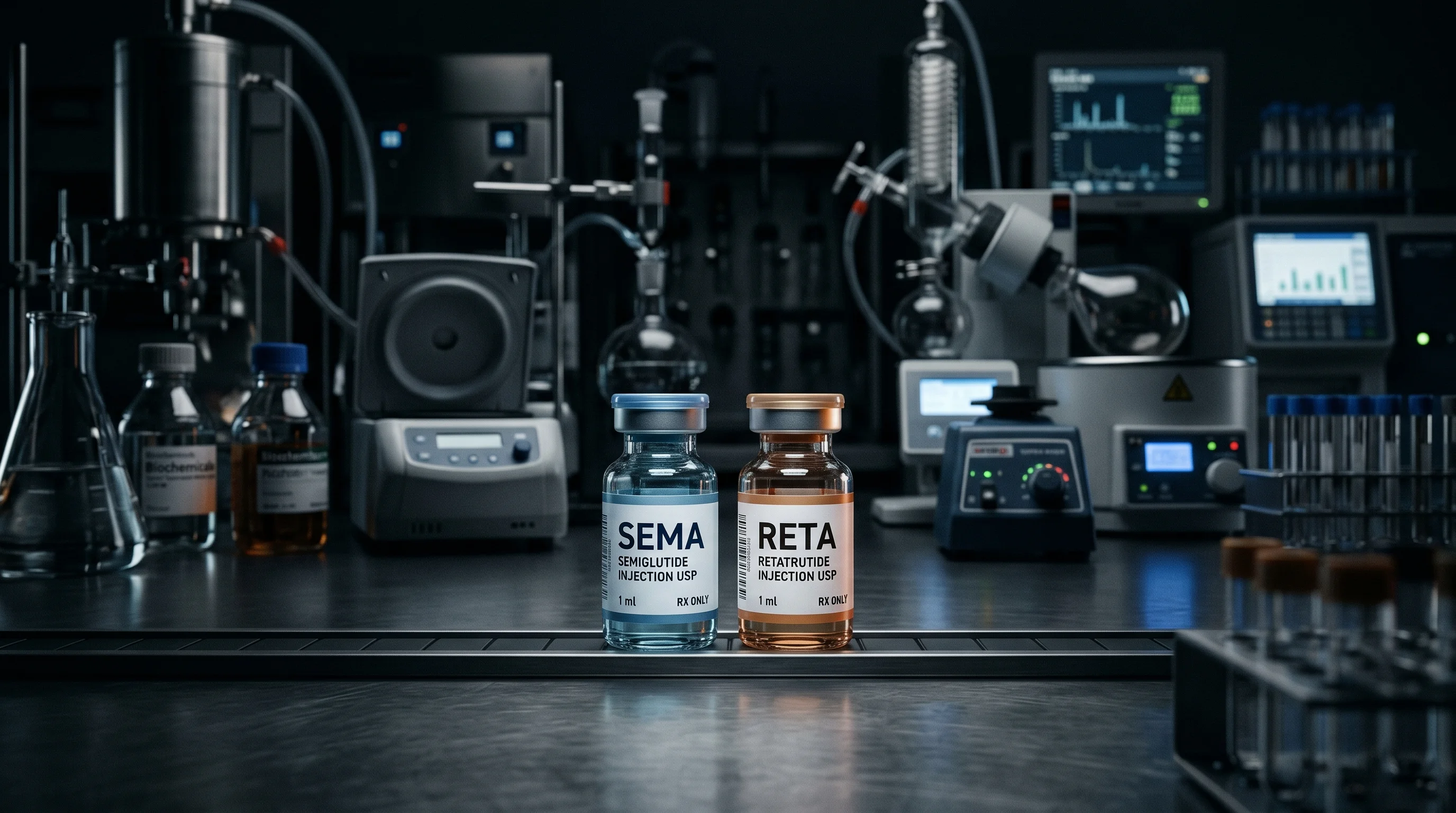
The mechanism explains why. Semaglutide targets one receptor. Retatrutide targets three. This comparative research overview examines both peptides across their molecular architecture, clinical evidence, pharmacokinetic profiles, side effect patterns, regulatory status, and research utility.
Molecular Mechanism: Mono vs Triple Agonism
Semaglutide: The Precision GLP-1 Agonist
Semaglutide is a 31-amino acid peptide analogue of native glucagon-like peptide-1 (GLP-1), a hormone secreted from intestinal L-cells in response to nutrient ingestion. CAS 910463-68-2, molecular weight 4,113.58 g/mol. Novo Nordisk engineered it with two structural modifications:
Modification 1 — Position 8 substitution: Alanine replaced by α-aminoisobutyric acid (Aib), conferring complete resistance to DPP-4 degradation. Native GLP-1 has a plasma half-life under 2 minutes; this single substitution eliminates that vulnerability entirely.
Modification 2 — C18 fatty acid linker at Lys26: A C18 diacid attached via mini-PEG spacer dramatically enhances albumin binding, protecting semaglutide from renal filtration and extending plasma half-life to ~165 hours — enabling once-weekly dosing.
At the receptor level, semaglutide is a selective GLP-1R agonist — activating adenylate cyclase, elevating intracellular cAMP, and triggering glucose-dependent insulin secretion. Beyond the pancreas, GLP-1R expression in hypothalamic nuclei (arcuate nucleus, nucleus tractus solitarius) drives central appetite suppression via POMC/AgRP neuronal circuits. This anorectic mechanism is responsible for the majority of STEP trial weight loss.
Semaglutide's receptor selectivity is simultaneously its strength and its ceiling. STEP 1's −14.9% represents the practical upper bound of what single-receptor GLP-1R agonism can achieve in Phase 3 populations.
Retatrutide (LY3437943): Three Receptors, One Molecule
Retatrutide is a 39-amino acid peptide, CAS 2381089-83-2, MW ~4,732 g/mol, with a C20 dicarboxylic acid fatty chain enabling weekly dosing. Its discovery was published by Coskun T et al. in Molecular Metabolism 2022 (PMID 35985340), describing how a peptide backbone leveraging GIP/GLP-1 sequence homology was engineered into a simultaneous three-receptor agonist.
GLP-1R agonism drives glucose-dependent insulin secretion, appetite suppression, and slowed gastric emptying — identical in mechanism to semaglutide.
GIPR agonism amplifies the incretin effect and appears to attenuate GI side effects — a pattern supported by tirzepatide's dual GIP/GLP-1 clinical data.
GCGR agonism is the decisive differentiator. Glucagon receptor activation drives hepatic fatty acid β-oxidation, thermogenesis in brown adipose tissue, and increased resting metabolic rate. Previous concern about GCGR agonism centered on hepatic gluconeogenesis; retatrutide's design resolves this by counterbalancing GCGR-driven gluconeogenesis with enhanced insulin secretion from GLP-1R and GIPR activation.
The net pharmacological result: appetite suppression (GLP-1R), amplified incretin effect with improved GI tolerability (GIPR), and elevated fat oxidation with increased metabolic rate (GCGR). Weight loss requires either reduced energy intake or increased expenditure — or both. Semaglutide addresses intake. Retatrutide addresses both simultaneously.
Clinical Efficacy Compared
Semaglutide: The STEP Program
Novo Nordisk's STEP program covers 8 trials across diverse populations.
STEP 1 (NEJM 2021, PMID 33567185): 1,961 adults with obesity or overweight + comorbidity, semaglutide 2.4 mg once weekly. At 68 weeks: mean weight loss −14.9% vs −2.4% placebo. 86.4% achieved ≥5% weight loss; 32.0% achieved ≥15% loss. Mean absolute reduction: −15.3 kg.
STEP 2 (Lancet 2021, PMID 33667417): Davies M et al. studied 1,210 adults with T2D and obesity. At 68 weeks: −9.6% weight loss, −1.6 pp HbA1c reduction. T2D populations consistently show attenuated weight loss responses in pharmacotherapy trials.
STEP 4: Rubino D et al. (PMID 33755728) confirmed the now-established pattern of significant weight regain after discontinuation — raising important questions about treatment duration and molecular dependency.
Retatrutide: Phase 2 Data
Obesity Phase 2 (NEJM 2023, PMID 37366315): Jastreboff AM et al. randomized 338 adults with obesity to doses 1–12 mg or placebo. At 48 weeks, the 12 mg group achieved: mean weight loss −24.2%; ≥15% weight loss in 83%; ≥20% weight loss in 63%; ≥25% weight loss in 26%. At 8 mg: −17.5%. These results, over a shorter follow-up than STEP 1, fundamentally exceeded the established benchmark.
T2D Phase 2 (Lancet 2023, PMID 37385280): Rosenstock J et al. demonstrated −2.2 pp HbA1c reduction and −16.9% weight loss at maximum dose in T2D patients — dramatically exceeding semaglutide's T2D result of −9.6%.
Positioning via tirzepatide: No direct semaglutide vs retatrutide head-to-head trial exists. However, SURPASS-2 (Frías JP et al., PMID 34170647) showed tirzepatide surpassing semaglutide 1 mg, and SURMOUNT-1 (Jastreboff AM et al., PMID 35658024) showed tirzepatide at 15 mg producing −20.9% at 72 weeks. The hierarchy — semaglutide (−14.9%) → tirzepatide (−20.9%) → retatrutide (−24.2%) — tracks precisely with incremental receptor engagement. See our tirzepatide research protocol for the dual-agonist perspective.
Pharmacokinetics Side by Side
↔ Scroll horizontally to view the full table on mobile.
| Parameter | Semaglutide | Retatrutide |
|---|---|---|
| CAS Number | 910463-68-2 | 2381089-83-2 |
| Molecular Weight | 4,113.58 g/mol | ~4,732 g/mol |
| Amino Acids | 31 aa | 39 aa |
| Fatty Acid Chain | C18 diacid | C20 dicarboxylic |
| Albumin Binding | >99% | >98% |
| Half-life (T½) | ~165h (~7 days) | ~144h (~6 days) |
| Dosing Frequency | Once weekly (SubQ) | Once weekly (SubQ) |
| Receptor Targets | GLP-1R only | GLP-1R + GIPR + GCGR |
| Time to Steady State | ~4–5 weeks | ~4–5 weeks |
| Renal Elimination | Minimal (albumin protected) | Minimal (albumin protected) |
Both peptides reach plasma via subcutaneous depot absorption (Tmax 24–72h), with albumin binding protecting against DPP-4 degradation and renal filtration. Steady-state concentrations are reached after 4–5 weekly doses for both. Semaglutide's marginally longer half-life (~21h difference) provides slightly smoother inter-dose plasma levels, though both maintain pharmacologically relevant trough concentrations throughout the weekly cycle.
Side Effect Profiles
Gastrointestinal: The Dominant Signal
Both peptides share the GLP-1R class effect: gastrointestinal events during dose escalation. GLP-1R activation in the GI tract slows gastric emptying and modulates gut motility, producing nausea, vomiting, diarrhea, and constipation — dose-dependent and concentrated in weeks 1–16.
Semaglutide (STEP 1, PMID 33567185): Nausea 44.2% vs 16.0% placebo; vomiting 24.8% vs 6.8%; diarrhea 29.7% vs 15.9%; discontinuation ~4.5%. Wharton et al. (PMID 34514682) confirmed the dose-escalation-dependent pattern with resolution of nausea in most completers.
Retatrutide (Phase 2, PMID 37366315): Nausea ~47%; vomiting ~26%; diarrhea ~19% at 12 mg; discontinuation ~6–7% at highest dose. GI profile broadly similar to semaglutide, potentially marginally higher at maximum doses where GLP-1R agonism intensity dominates the GIPR modulating effect.
Non-GI Considerations
Both peptides produce modest heart rate increases (+1–4 bpm, class effect). Semaglutide's established cardiovascular safety profile (SUSTAIN-6: 26% MACE reduction) is a key differentiator; retatrutide's GCGR agonism raises theoretical chronotropic questions that Phase 3 TRIUMPH will definitively address.
Lean mass concern: The magnitude of retatrutide-driven weight loss (−24.2%) raises important questions about lean mass preservation. DEXA body composition endpoints in TRIUMPH Phase 3 will characterize the fat-to-lean mass loss ratio — a critical parameter for evaluating the true metabolic quality of the weight loss.
Regulatory Status
Semaglutide: Fully Approved
Ozempic (0.5 mg, 1 mg, 2 mg injectable weekly) — FDA approved December 2017 (T2D); EMA February 2018.
Wegovy (2.4 mg injectable weekly) — FDA approved June 2021 (chronic weight management); EMA January 2022.
Rybelsus (3/7/14 mg oral tablet) — FDA approved September 2019 (T2D); first approved oral GLP-1R agonist.
Retatrutide: Phase 3, No Approval
Retatrutide holds no regulatory approval from FDA, EMA, or any authority as of 2026. Eli Lilly's TRIUMPH Phase 3 program is actively enrolling. Based on Phase 2 results and established GLP-1 class regulatory precedent, earliest possible FDA submission is estimated 2026–2027, with potential approval 2027–2028. Retatrutide is a research-use-only (RUO) compound. Its use outside a formally approved clinical trial is not sanctioned by any regulator.

Master Comparison Table: 12 Dimensions
↔ Scroll horizontally to view the full table on mobile.
| Dimension | Semaglutide | Retatrutide |
|---|---|---|
| Receptor Targets | GLP-1R only | GLP-1R + GIPR + GCGR |
| Phase 3 Weight Loss | −14.9% (STEP 1, 68 wks) | Phase 3 ongoing (Phase 2: −24.2% at 48 wks) |
| T2D HbA1c Reduction | −1.6 pp (STEP 2) | −2.2 pp (Phase 2) |
| Half-life | ~165h (~7 days) | ~144h (~6 days) |
| Dosing Frequency | Once weekly SubQ | Once weekly SubQ |
| Regulatory Status | FDA + EMA approved | Phase 3, no approval |
| GI Side Effects (Nausea) | 44.2% (STEP 1) | ~47% (Phase 2, 12 mg) |
| GI Discontinuation | ~4.5% | ~6–7% (highest dose) |
| CV Outcomes Data | −26% MACE (SUSTAIN-6) | Phase 3 data pending |
| MASLD/Liver Benefit | Limited data | Significant (GCGR-driven β-oxidation) |
| Estimated Market Approval | Approved (2017/2021) | 2027–2028 (estimated) |
| Research Availability | Commercial approved drug | RUO research compound |
Research Applications
Semaglutide in Preclinical Research
Despite being an approved medication, semaglutide remains actively investigated in preclinical settings. Key research directions include: neurodegeneration (GLP-1R neuroprotection in Parkinson's/Alzheimer's rodent models; reduced neuroinflammation, hippocampal neurogenesis, amyloid-beta attenuation); NAFLD/MASLD comparative biology (where semaglutide's limited fibrosis regression creates a mechanistic gap vs GCGR-based compounds); cardioprotection mechanism dissection (direct vs indirect GLP-1R cardiac effects in cardiomyocyte models); and gut microbiome interaction mapping.
Retatrutide as a Research Tool
Retatrutide enables research lines that GLP-1R mono-agonists cannot address:
- Triple receptor pharmacology: In vitro cAMP assays, biased agonism studies, and receptor binding kinetics characterization — foundational for next-generation molecule design
- GCGR pathway in hepatocyte models: Isolated investigation of glucagon receptor contribution to fatty acid oxidation, VLDL metabolism, and gluconeogenesis regulation
- GIPR adipocyte biology: Modulation of adipogenesis and lipolysis via pathways distinct from β-adrenergic stimulation
- Brown adipose tissue thermogenesis: GCGR activation in BAT models — requires triple agonists to study in combination with GLP-1R satiety circuit effects
- Comparative receptor pharmacology: Dissection of individual receptor contributions using selective antagonists in combination with retatrutide
For the full landscape of triple agonist research applications, see our GLP-1 triple agonists research overview and complete retatrutide research guide.
Reconstitution and Storage (RUO)
Research-grade retatrutide is supplied as lyophilized powder. Reconstitution vehicle: sterile WFI or 0.9% NaCl; for long-term stocks, 10 mM acetic acid (pH ~4.5) improves stability.
Protocol: Equilibrate vial to room temperature → add solvent slowly against vial wall → rotate gently (no vortex/vigorous shaking) → confirm clear solution → aliquot immediately. Storage: lyophilized at −20°C protected from light; reconstituted stock (≤1 mg/mL) at −20°C for up to 4–6 weeks; working solutions fresh at 4°C, used within 24–48h. Maximum 3 freeze-thaw cycles.
Semaglutide research-grade peptide follows similar protocols and is widely used as a GLP-1R positive control in functional assays — an established internal benchmark against which novel GLP-1R agonists are compared.
Always verify CoA for purity (≥98% HPLC), identity (MS), and endotoxin levels before use in in vivo models. See our complete peptide reconstitution guide and CoA interpretation guide.
Unik Lab offers Retatrutide 5mg for research applications at €69/vial with HPLC verification and accompanying CoA. Semaglutide is not currently in our research catalog; researchers requiring GLP-1R reference standards should consult our research peptides sourcing guide.
Frequently Asked Questions
Is retatrutide more effective than semaglutide?
In Phase 2 clinical trial data, retatrutide at 12 mg produced mean weight loss of −24.2% at 48 weeks (Jastreboff AM et al., NEJM 2023, PMID 37366315), compared to semaglutide's established benchmark of −14.9% at 68 weeks in STEP 1 (Wilding JPH et al., NEJM 2021, PMID 33567185). The 9.3 percentage-point difference, over a shorter follow-up, is substantial. No direct head-to-head Phase 3 data exists. Retatrutide's advantage derives from engaging GIPR and GCGR in addition to GLP-1R — simultaneously addressing both energy intake and expenditure.
What receptors does retatrutide activate that semaglutide does not?
Semaglutide is a selective GLP-1R mono-agonist. Retatrutide additionally activates GIPR (glucose-dependent insulinotropic polypeptide receptor) and GCGR (glucagon receptor). GIPR enhances the incretin effect and attenuates GI side effects. GCGR drives hepatic fatty acid β-oxidation, brown adipose thermogenesis, and elevated resting metabolic rate — mechanisms that semaglutide cannot access.
Is semaglutide approved for human use? Is retatrutide?
Semaglutide holds full FDA and EMA approval: Ozempic (T2D, 2017) and Wegovy (chronic weight management, 2021). Retatrutide has no regulatory approval from any authority as of 2026. It is in Phase 3 TRIUMPH trials; earliest potential FDA approval is estimated 2027–2028. Retatrutide is available only as a research-use-only (RUO) compound.
What are the main side effects of both peptides?
Both share the GLP-1R class GI side effect profile: nausea, vomiting, diarrhea, constipation — dose-dependent and concentrated during weeks 1–16. Semaglutide STEP 1: 44.2% nausea, ~4.5% GI discontinuation. Retatrutide Phase 2 at 12 mg: ~47% nausea, ~6-7% GI discontinuation. Both produce modest heart rate increases (+1–4 bpm). Semaglutide has an established cardiovascular safety record; retatrutide's CV data from Phase 3 TRIUMPH is pending.
What is the difference in half-life between semaglutide and retatrutide?
Semaglutide: ~165 hours (~7 days) via C18 fatty acid albumin binding + DPP-4 resistance at position 8. Retatrutide: ~144 hours (~6 days) via C20 dicarboxylic acid chain. The ~21-hour difference is modest; both support once-weekly subcutaneous dosing with adequate trough concentrations and reach steady state after ~4–5 weeks.
Where does tirzepatide fit in the GLP-1 agonist hierarchy?
Tirzepatide (LY3298176) is a dual GLP-1R/GIPR agonist. In SURMOUNT-1 (Jastreboff AM et al., PMID 35658024), it produced −20.9% weight loss at 72 weeks — surpassing semaglutide's −14.9% but below retatrutide's Phase 2 −24.2%. The hierarchy is: semaglutide → tirzepatide → retatrutide, each step adding a receptor engagement.
What is the research use case for comparing these two peptides in vitro?
Semaglutide serves as the GLP-1R mono-agonist reference standard. Comparing it against retatrutide's three-receptor profile allows isolation of GIPR and GCGR pathway contributions to downstream metabolic signaling via parallel cAMP assays, gene expression in hepatocytes/adipocytes/β-cells, and competitive binding studies. It is a foundational tool for next-generation incretin compound design.
References
- Wilding JPH et al. "Once-Weekly Semaglutide in Adults with Overweight or Obesity." NEJM 2021. PMID 33567185
- Davies M et al. "Semaglutide 2.4 mg once a week in adults with overweight or obesity, and type 2 diabetes (STEP 2)." Lancet 2021. PMID 33667417
- Coskun T et al. "LY3437943, a novel triple glucagon, GIP, and GLP-1 receptor agonist." Mol Metab 2022. PMID 35985340
- Jastreboff AM et al. "Triple-Hormone-Receptor Agonist Retatrutide for Obesity — A Phase 2 Trial." NEJM 2023. PMID 37366315
- Rosenstock J et al. "Retatrutide, a GIP, GLP-1 and glucagon receptor agonist, for people with type 2 diabetes." Lancet 2023. PMID 37385280
- Jastreboff AM et al. "Tirzepatide Once Weekly for the Treatment of Obesity." NEJM 2022. PMID 35658024
Retatrutide 5mg — Research Grade 🇪🇺
HPLC ≥98% · CoA included · EU sourced · Semaglutide not in catalog at this time